
Carbon Cycle Diagram Maker
Generate carbon cycle diagrams: reservoirs and fluxes in GtC, a simple box-and-arrow school version, the ocean carbon pumps and the carbon and oxygen cycle. For earth-science lessons, climate explainers and papers.
Carbon cycle diagram examples
Each card is what its prompt actually drew: the global reservoir-and-flux schematic with stocks in GtC and fluxes per year, a six-box school version with the process written on every arrow, the ocean carbon cycle from surface to seafloor, and the carbon and oxygen cycle as producers and consumers with their equations. Clicking a card loads that prompt so you can rewrite it.
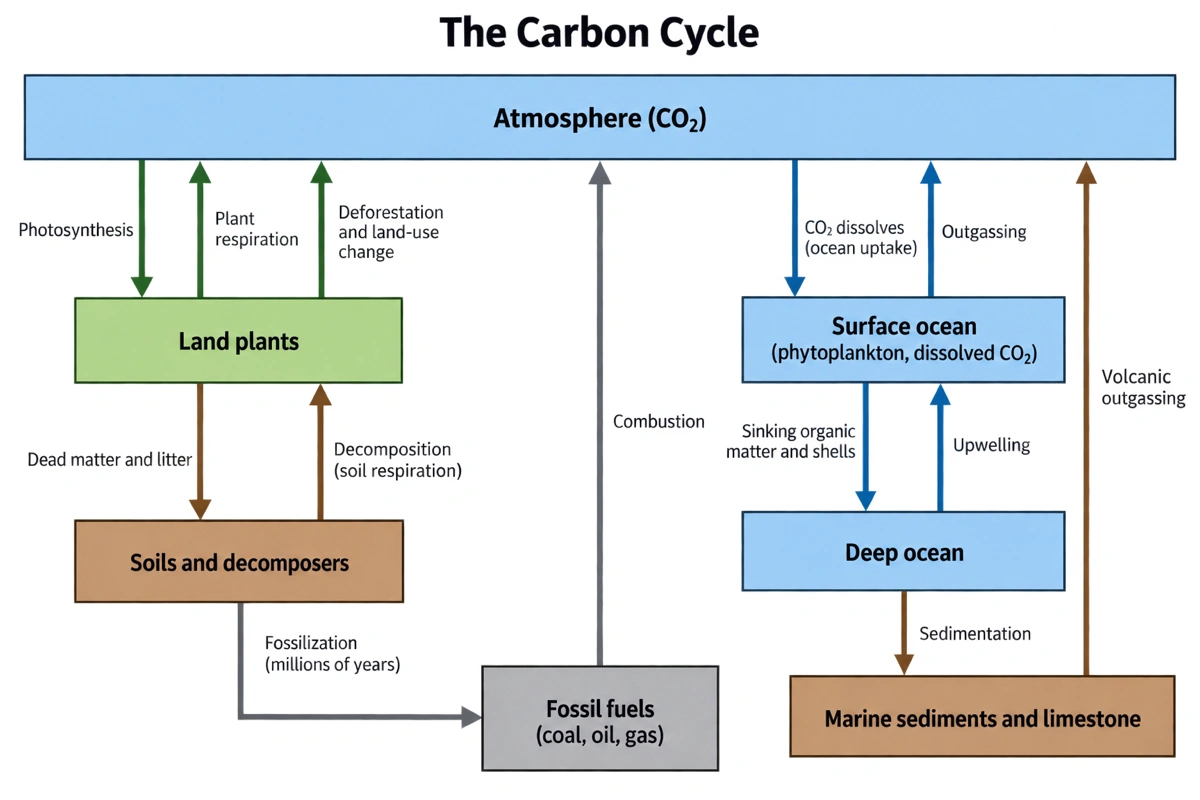
Labeled carbon cycle diagram: where each arrow takes the carbon
Read the land column on the left, the fossil-fuel branch in the middle, then the ocean column on the right. Every arrowhead sits on the box the carbon moves into.
- 1
Photosynthesis and plant respiration
Land plants take CO₂ down from the atmosphere; respiration and forest clearing send some straight back up.
- 2
Litter and decomposition
Dead matter and litter feed the soil, where decomposers respire the carbon back to the atmosphere.
- 3
Fossilization → combustion
Over millions of years soil carbon becomes coal, oil and gas; combustion returns it to the air at once.
- 4
Ocean and sediments
The sea takes up and outgasses CO₂; sinking shells become sediment, released again by volcanoes.
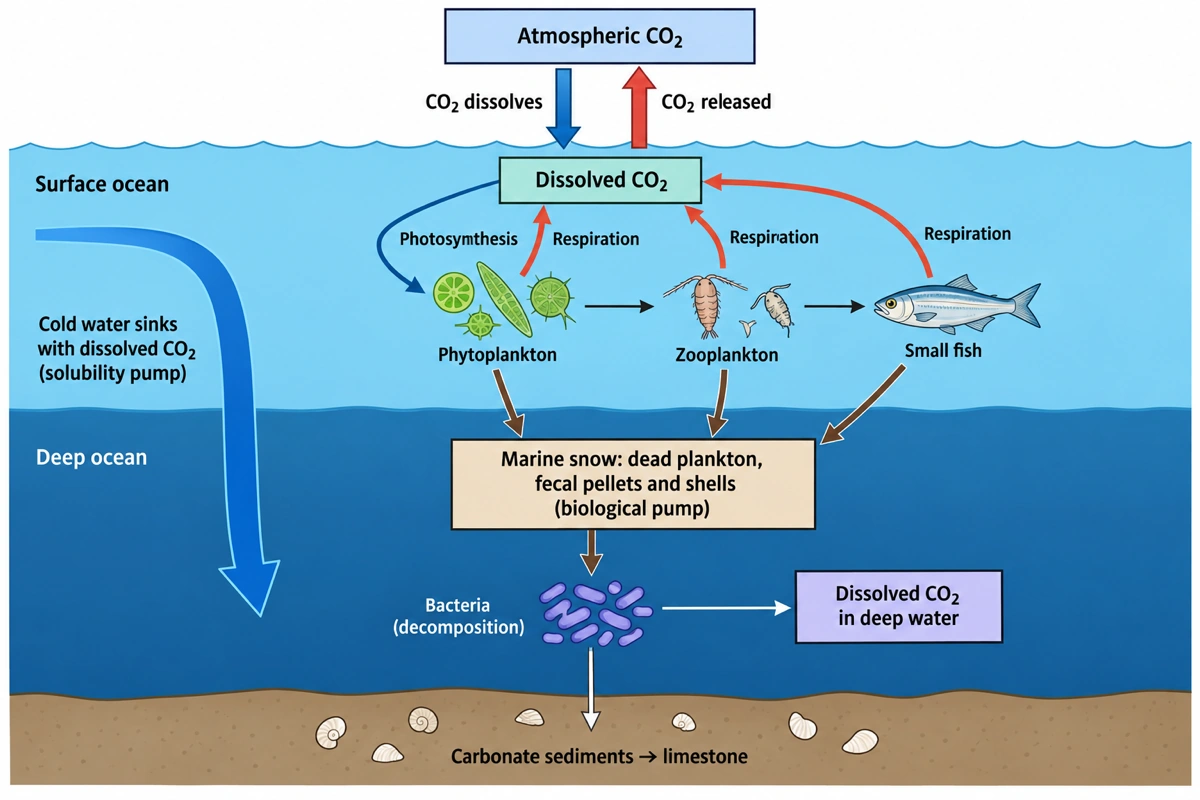
The ocean carbon cycle: how CO₂ reaches the deep sea
The ocean column of the labeled figure, opened up from the surface to the seafloor. Two pumps carry carbon down.
- 1
Surface exchange and photosynthesis
CO₂ dissolves into the water; phytoplankton fix it, and plankton and fish respire it back.
- 2
Biological pump
Dead plankton, fecal pellets and shells sink as marine snow; bacteria at depth respire it to CO₂.
- 3
Solubility pump and sediments
Cold polar water sinks with its dissolved CO₂; shells that reach the floor become limestone.
Carbon cycle diagrams: labeled, simple, modeled, oceanic and human-altered
The same carbon moves through every one of these; what changes is how much of the planet the figure shows and whether it carries numbers. These are the versions people search for, and what each one should contain.
Carbon cycle diagram with labels
The full figure for a biology or earth-science class. Reservoirs: the atmosphere, land plants, animals, soil and its decomposers, fossil fuels, the ocean and carbonate rock. Processes, one arrow each: photosynthesis, respiration, feeding, death and waste, decomposition, burial, combustion, dissolving into and escaping from the sea, sedimentation and volcanic eruption. Only photosynthesis and dissolving point down out of the air; every other arrow that touches the sky points up.
Simple carbon cycle diagram
The basic carbon cycle diagram for a first lesson: CO₂ in the air, plants, animals, dead remains, fossil fuels and burning, joined by photosynthesis, feeding, respiration, decomposition and combustion. No ocean, no rocks, no numbers. It still has to show that plants respire as well as photosynthesize — the arrow most often left off a simplified carbon cycle is the one from plants back up to the air.
Carbon cycle drawing you can copy
For a carbon cycle drawing by hand, use boxes rather than scenery and lay them out in three rows: the atmosphere across the top, plants and animals in the middle, soil and fossil fuels at the bottom, with the ocean down one side. Draw every box first, then the arrows: one down from the atmosphere into the plants, and up arrows from everything that breathes, decays or burns. Eight to ten arrows is plenty for a hand-drawn version.
Carbon cycle model with reservoirs and fluxes
The model version replaces scenery with numbers: each store in gigatonnes of carbon (GtC) and each arrow in GtC per year. Rough sizes — atmosphere about 870, vegetation about 450, soils about 1,700, surface ocean about 900 and deep ocean about 37,000, remaining fossil fuel reserves 1,000–1,500, sedimentary rock tens of millions. Fluxes: photosynthesis about 120 GtC/yr, returned as about 60 by plant respiration and 60 by soils; ocean uptake about 80 against about 78 outgassed; fossil fuels and cement about 10; volcanoes about 0.1.
Carbon and oxygen cycle
The paired figure: photosynthesis takes in CO₂ and water and gives out glucose and O₂; cellular respiration takes in glucose and O₂ and gives out CO₂ and water. Drawn as two boxes, producers and consumers, joined by a CO₂ arrow one way and an O₂ arrow the other, with the two equations underneath — 6CO₂ + 6H₂O → C₆H₁₂O₆ + 6O₂ and its reverse. Note that producers respire too, or students conclude plants only make oxygen.
Ocean carbon cycle diagram
The sea in cross-section: CO₂ dissolving at the surface and forming carbonic acid, bicarbonate and carbonate ions; phytoplankton fixing it; dead plankton and shells sinking as marine snow (the biological pump); cold, dense water sinking at high latitudes with its dissolved carbon (the solubility pump); and calcium carbonate settling on the seafloor as the start of limestone. Add a pH label to show ocean acidification.
Human impact on the carbon cycle
The natural loop plus the arrows people added: fossil-fuel combustion and cement making (about 10 GtC a year), forest clearing and burning (about 1–1.5 GtC a year), and a growing atmosphere box — CO₂ up from about 280 ppm before 1800 to over 420 ppm now. Of the extra carbon, about 30% has gone into the ocean and about 25% into land plants; the rest stays in the air.
Slow and fast carbon cycle
Two loops at two speeds. The fast cycle runs through living things in a lifetime — photosynthesis, respiration and decay move 1,000 to 100,000 million tonnes of carbon a year. The slow cycle runs through rocks over 100–200 million years: rain weathers rock, rivers carry the carbon to the sea, it settles as limestone, and subduction and volcanoes eventually return it, at only 10–100 million tonnes a year.
Steps of the carbon cycle: each process and where it moves carbon
The processes a labeled carbon cycle diagram names on its arrows, in the order most textbooks follow — the biological loop first, then the long-term stores and the ocean.
| Process | Carbon moves from → to | What happens |
|---|---|---|
| Photosynthesis | Atmosphere → plants and algae | Light energy turns CO₂ and water into glucose, releasing O₂ |
| Feeding | Plants → animals | Herbivores, then carnivores, take in carbon as the plant's sugars, fats and proteins |
| Cellular respiration | Plants, animals, microbes → atmosphere | Glucose is broken down with O₂ for energy, giving off CO₂ and water |
| Death and waste | Plants and animals → soil | Leaf litter, dead bodies and dung become soil organic matter |
| Decomposition | Soil → atmosphere | Bacteria and fungi respire the dead material, releasing CO₂ (and methane where there is no oxygen) |
| Burial and fossilization | Dead matter → fossil fuels | Over millions of years, buried remains under heat and pressure become coal, oil and natural gas |
| Combustion | Fossil fuels and wood → atmosphere | Burning oxidizes stored carbon back to CO₂ in seconds |
| Dissolving (diffusion) | Atmosphere → ocean | CO₂ dissolves at the surface, forming carbonic acid, bicarbonate and carbonate ions |
| Outgassing | Ocean → atmosphere | Warm surface water releases dissolved CO₂ back to the air |
| Sedimentation | Ocean → seafloor rock | Calcium carbonate shells settle and harden into limestone |
| Volcanic eruption | Rock → atmosphere | Subducted carbonate rock melts and its carbon escapes as CO₂ |
A school carbon cycle usually stops at the first seven rows; earth-science courses add the ocean and rock rows. Weathering of silicate rock, which slowly draws CO₂ out of rainwater over millions of years, belongs on the slow-cycle version. Name the processes your syllabus lists and only those arrows are drawn.
What is the carbon cycle?
The carbon cycle is the movement of carbon between the atmosphere, living things, soils, the ocean and rocks: plants and algae take carbon dioxide out of the air by photosynthesis, and respiration, decomposition, combustion and volcanoes return it. A carbon cycle diagram draws each store as a box or a scene and each transfer as a one-way arrow, so the carbon can be followed from the air into a leaf and back out again.
Key facts
- CO₂ is only about 0.04% of the air, roughly 420 parts per million. Before the Industrial Revolution it was about 280 ppm; the rise comes from burning fossil fuels and clearing forests.
- Most of Earth's carbon is locked in rock. NASA puts it at about 65,500 billion tonnes, mostly as limestone formed from the calcium carbonate shells of marine organisms — the largest carbon reservoir on the planet.
- The ocean holds roughly 50 times as much carbon as the atmosphere. More than 90% of it is dissolved as bicarbonate ions, made when CO₂ reacts with seawater.
- Photosynthesis and respiration nearly cancel out. Each moves on the order of 120 billion tonnes of carbon a year on land; fossil-fuel burning adds about 10, small by comparison but one-way, so it accumulates in the air.
- Carbon moves at two speeds. Through living things it cycles within a lifespan; through rocks, weathering, sediments and volcanoes it takes 100–200 million years.
Carbon cycle vs nitrogen cycle
Both are biogeochemical cycles that run through the air, soil and living things, but carbon enters life directly through photosynthesis, while nitrogen has to be fixed by bacteria before any plant can use it. That is why the carbon cycle is drawn around plants and the nitrogen cycle around soil microbes.
| Carbon cycle | Nitrogen cycle | |
|---|---|---|
| Form in the air | CO₂, about 0.04% of the atmosphere | N₂, about 78% of the atmosphere |
| Way into living things | Photosynthesis by plants, algae and cyanobacteria | Fixation by bacteria, then roots take up ammonium and nitrate |
| Way back to the air | Respiration, decomposition and combustion | Denitrification by bacteria |
| Largest store | Sedimentary rock such as limestone | The atmosphere |
| Main human change | Fossil fuels and deforestation add CO₂ | Fertilizer doubles the nitrogen fixed each year |
| Effect of the excess | Warming and ocean acidification | Algal blooms and dead zones in water |
The two cycles meet in every living cell. Proteins and nucleic acids need both elements, so a plant's carbon gain from photosynthesis is limited by how much fixed nitrogen its roots can find — the reason nitrogen fertilizer raises crop growth.
Questions about the carbon cycle
What is the carbon cycle in simple terms?
Carbon goes round and round: plants take carbon dioxide out of the air to grow, animals eat the plants, and everything that breathes, rots or burns puts the carbon back into the air. Some carbon gets stuck for a very long time on the way — as coal, oil and gas underground, or as limestone on the seabed — and comes back only when fuel is burned or rock is melted by a volcano.
How do you draw a carbon cycle?
Draw the stores as boxes first and the arrows last. Put an atmosphere box across the top, plants and animals in the middle row, soil with its decomposers and fossil fuels in the bottom row, and the ocean down one side. Then draw one arrow from the atmosphere down into the plants (photosynthesis) and arrows up to the atmosphere from the plants, the animals and the soil (respiration and decomposition) and from the fossil fuels (combustion). Finish with plants → animals (feeding), plants and animals → soil (death and waste), soil → fossil fuels (fossilization) and the two ocean arrows, in and out. Check that every arrow points the way the carbon goes.
What are the steps of the carbon cycle?
Photosynthesis, feeding, respiration, death and decomposition, burial into fossil fuels, and combustion — in that order, the carbon goes from the air into plants, into animals, back to the air or into the soil, and from buried remains back to the air when fuel is burned. Fuller versions add the ocean (dissolving, outgassing and sedimentation into limestone) and volcanic eruption.
How are the carbon and oxygen cycles connected?
Through the two reactions that run them both: photosynthesis uses CO₂ and releases O₂, and cellular respiration uses O₂ and releases CO₂. Fixing six CO₂ into one glucose frees six O₂; respiring that glucose uses the six O₂ and gives the six CO₂ back. That is why the two are often drawn as one figure, the carbon and oxygen cycle.
How do humans affect the carbon cycle?
Mainly by burning fossil fuels, which moves carbon buried over millions of years into the air within a few centuries, and by clearing forests. Together they add roughly 11 billion tonnes of carbon a year. The ocean and land plants absorb a little over half of it; the rest has raised atmospheric CO₂ from about 280 to over 420 ppm, warming the climate and making seawater more acidic.
How does deforestation affect the carbon cycle?
It adds carbon to the air twice. Burning or rotting the cleared trees releases the carbon stored in their wood, and the land then has fewer plants to pull CO₂ out of the air by photosynthesis. Disturbed soil releases some of its own carbon as well. On a carbon cycle diagram it is drawn as an extra up arrow from the forest and a thinner photosynthesis arrow.
What role does combustion play in the carbon cycle?
Combustion returns carbon to the atmosphere as CO₂ by burning it with oxygen — wood, wildfires, and coal, oil and natural gas. Burning wood returns carbon a tree took up within its lifetime; burning fossil fuels returns carbon that was out of the cycle for millions of years, which is why it raises the amount in the air instead of keeping it level.
What role does photosynthesis play in the carbon cycle?
It is the main way carbon leaves the air and enters living things. Plants on land and phytoplankton in the sea use light energy to turn CO₂ and water into glucose, and every food chain on the diagram starts from that sugar. It is the one big downward arrow from the atmosphere on a land carbon cycle diagram.
What do decomposers do in the carbon cycle?
Bacteria and fungi break down dead plants, dead animals and waste and respire the carbon in them back to the air as CO₂. Without them carbon would pile up in dead material. Where oxygen is short — waterlogged peat, deep mud — decomposition slows, and the carbon can be buried long enough to become coal or oil.
How does the ocean store carbon?
CO₂ dissolves at the surface and reacts with water to form bicarbonate and carbonate ions; phytoplankton take some of it up, and two pumps carry it down. Dead plankton and shells sink as marine snow (the biological pump), and cold water sinking near the poles takes dissolved carbon to the deep sea (the solubility pump). Shells that reach the floor build up as carbonate sediments that become limestone.
Why is the carbon cycle important?
It keeps the amount of CO₂ in the air — and therefore Earth's temperature — fairly steady, and it supplies the carbon every living thing is built from. Carbon dioxide traps heat, so when the cycle is pushed out of balance, as fossil-fuel burning is doing now, the climate warms and the ocean becomes more acidic.
Where is most of Earth's carbon stored?
In rocks, especially limestone and other carbonate sediments. After that come the deep ocean, as dissolved bicarbonate, then soils, fossil fuels, land plants and the atmosphere, which holds the least of the large stores but changes the fastest.
Sources
Keep exploring
Our other diagram tools, and the guides behind them.
Tools

Draw your carbon cycle diagram
Land, ocean, fossil fuels or the carbon and oxygen pair, with every arrow pointing the way the carbon goes.
Start drawing