
Bohr Model Diagram Maker
Name an element and get its Bohr model: protons and neutrons counted in the nucleus, electrons placed shell by shell — 2, 8, 8 for the first 20 elements. Or view the labeled and blank sodium diagrams below, free.
Or start from an example
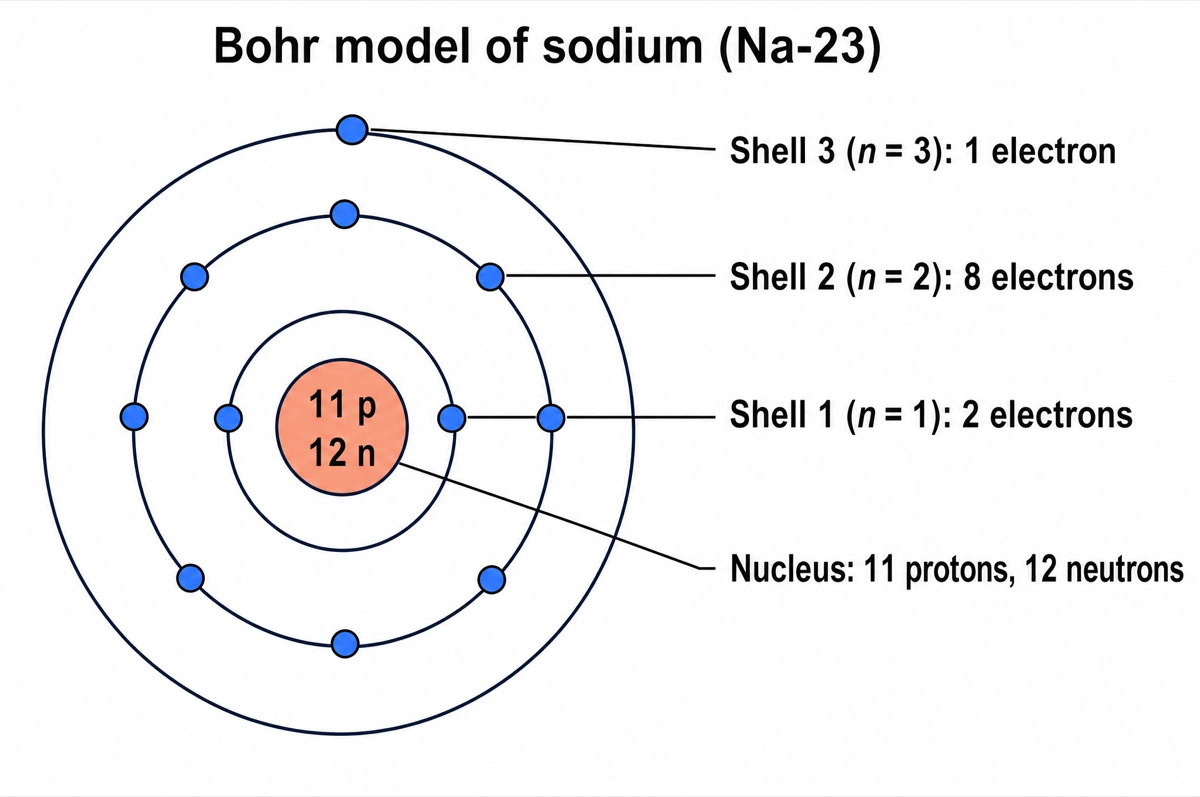
Labeled Bohr model of sodium (answer key)
Sodium-23 with 11 protons and 12 neutrons in the nucleus and its 11 electrons on three shells, 2, 8 and 1, every count labeled. Print it as the answer key, or hand it out as a revision sheet.
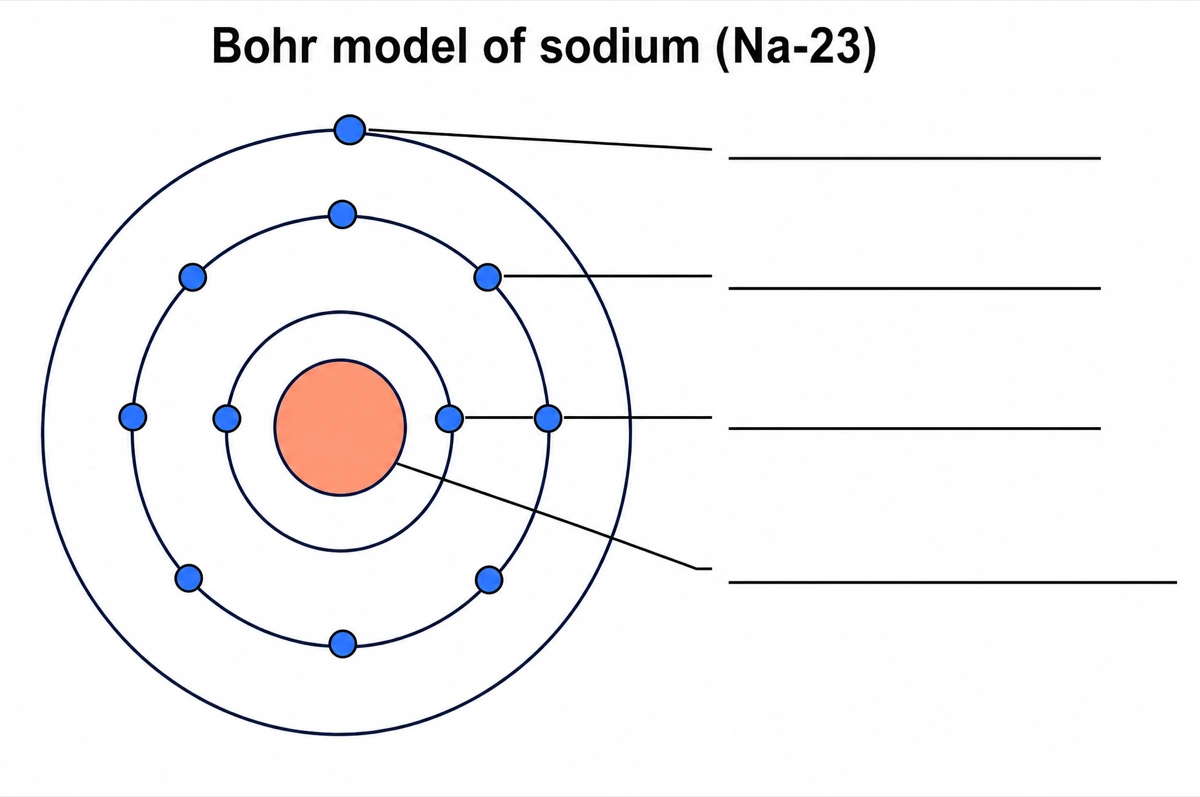
Blank Bohr model diagram to label
The same sodium atom with its electrons kept and an empty answer line where every label was — students fill in the protons, the neutrons and the electrons on each shell.
What is a Bohr model diagram?
A Bohr model diagram draws an atom as a small nucleus — its protons and neutrons counted inside — with the electrons on concentric circular shells around it, filled from the innermost shell outward. The number of protons is the atomic number, protons plus neutrons is the mass number, and the electrons on the outer shell are the valence electrons that decide how the element bonds.
Key facts
- Niels Bohr proposed it in 1913 for the hydrogen atom. Electrons move only in allowed orbits of fixed energy and give out or take in light only when they jump between them — which reproduced the hydrogen line spectrum and the Rydberg constant.
- A shell holds at most 2n² electrons — 2, 8, 18, 32. That is 2 in the first shell, 8 in the second and 18 in the third.
- School diagrams fill the third shell only to 8 for the first 20 elements. After argon the next electrons go into 4s, which lies below 3d, so potassium is drawn 2, 8, 8, 1 and calcium 2, 8, 8, 2 — although the third shell could hold 18.
- Neutrons = mass number − atomic number. Sodium-23 has 11 protons and 23 − 11 = 12 neutrons; carbon-12 has 6 of each. A neutral atom has as many electrons as protons.
- It is a teaching model, not the modern picture. Fixed orbits cannot explain atoms with more than one electron; the quantum mechanical model replaced them with orbitals, and molecular orbital theory carries that on to chemical bonds.
How does the Bohr model diagram maker work?
Name the element
Say which element or isotope and how much to show — a fully labeled atom, a simple one for a younger class, several elements side by side. A sentence is enough.
Pick a style
The default is a clean flat textbook plate — white background, concentric shells, labels on straight leader lines. Or apply watercolor, ink line art, 3D and other finishes.
Refine and export
The result opens in your workspace, where you can redraw regions, edit labels on the canvas, upscale and export in high resolution.
Bohr model electron arrangements of the first 20 elements
Protons, neutrons in the most common isotope, and electrons per shell for hydrogen to calcium — the numbers a Bohr model diagram of each element is checked against.
| Element | Protons | Neutrons | Electrons per shell |
|---|---|---|---|
| Hydrogen (H-1) | 1 | 0 | 1 |
| Helium (He-4) | 2 | 2 | 2 |
| Lithium (Li-7) | 3 | 4 | 2, 1 |
| Beryllium (Be-9) | 4 | 5 | 2, 2 |
| Boron (B-11) | 5 | 6 | 2, 3 |
| Carbon (C-12) | 6 | 6 | 2, 4 |
| Nitrogen (N-14) | 7 | 7 | 2, 5 |
| Oxygen (O-16) | 8 | 8 | 2, 6 |
| Fluorine (F-19) | 9 | 10 | 2, 7 |
| Neon (Ne-20) | 10 | 10 | 2, 8 |
| Sodium (Na-23) | 11 | 12 | 2, 8, 1 |
| Magnesium (Mg-24) | 12 | 12 | 2, 8, 2 |
| Aluminum (Al-27) | 13 | 14 | 2, 8, 3 |
| Silicon (Si-28) | 14 | 14 | 2, 8, 4 |
| Phosphorus (P-31) | 15 | 16 | 2, 8, 5 |
| Sulfur (S-32) | 16 | 16 | 2, 8, 6 |
| Chlorine (Cl-35) | 17 | 18 | 2, 8, 7 |
| Argon (Ar-40) | 18 | 22 | 2, 8, 8 |
| Potassium (K-39) | 19 | 20 | 2, 8, 8, 1 |
| Calcium (Ca-40) | 20 | 20 | 2, 8, 8, 2 |
Two conventions exist past calcium. School diagrams use 2, 8, 8 for the first 20 elements, as here; from scandium on, the third shell fills up toward its 18 — iron is 2, 8, 14, 2. Say which your course uses and the diagram follows it.
Bohr model vs quantum mechanical model: what is the difference?
The Bohr model puts each electron on a fixed circular orbit at a set distance from the nucleus; the quantum mechanical model replaces orbits with orbitals — regions where an electron is likely to be found — described by four quantum numbers. Bohr's numbered energy levels live on in the modern model as the principal quantum number n.
| Bohr model (1913) | Quantum mechanical model | |
|---|---|---|
| Where the electrons are | On fixed circular orbits | In orbitals — probability clouds with no set path |
| Energy levels | Quantized, numbered n = 1, 2, 3… | Quantized shells n, split into s, p, d and f subshells |
| Quantum numbers | One (n) | Four (n, l, mₗ, mₛ) |
| Atoms it describes exactly | Hydrogen and one-electron ions such as He⁺ | All atoms and molecules |
| What it explains | The hydrogen line spectrum | Spectra, chemical bonding, magnetism and the layout of the periodic table |
| Best used for | Counting protons, neutrons and electrons per shell; valence electrons | Electron configurations, orbital shapes, molecular orbital diagrams |
Use the Bohr model for what it gets right: electrons per shell and valence electrons. For orbital shapes, subshells or bonding, draw an electron configuration or a molecular orbital diagram instead.
Where are Bohr model diagrams used?
Bohr model diagrams are used mostly in middle-school and high-school science — labeling worksheets, element projects and exam revision — and in introductory physics to explain line spectra. What changes is the depth: electrons per shell in a first course, energy levels and emitted light in physics.
Middle-school science
Element worksheets and projects: count the protons, neutrons and electrons of one element and draw them in place. Usually the labeled atom, plus the same drawing blank.
High-school chemistry
GCSE, AP and IB chemistry: electron arrangements such as 2, 8, 1, valence electrons, and why elements in one group of the periodic table react alike.
Introductory physics
The energy levels of the hydrogen atom and the photon given out when an electron drops from n = 3 to n = 2 — the red 656 nm line of the Balmer series.
Ions and isotopes
Side-by-side diagrams of an atom and its ion (Na and Na⁺) or of two isotopes (carbon-12 and carbon-14), where only the electron or the neutron count changes.
Common questions about Bohr model diagrams
What should a labeled Bohr model diagram include?
The nucleus with its number of protons and neutrons, each electron shell drawn as a circle, the electrons as dots or crosses on the shells, and the count on each shell. Many worksheets also ask for the element symbol, atomic number and mass number. That is the default — ask for fewer labels and only those are drawn.
Can I get a blank Bohr model diagram for students to fill in?
Yes — view the blank sodium version on this page free, or ask for any element and every label is replaced by an empty answer line. Ask for empty shells as well and students draw the electrons themselves.
How many electrons go in each shell of a Bohr model?
2 in the first shell, 8 in the second and, for the first 20 elements, 8 in the third before the fourth begins. The upper limit is 2n² — 2, 8, 18, 32 — but the 4s subshell fills before 3d, so potassium is 2, 8, 8, 1, not 2, 8, 9.
How do I find the number of neutrons for a Bohr model?
Subtract the atomic number from the mass number. Oxygen-16 has 8 protons and 16 − 8 = 8 neutrons; chlorine-35 has 17 protons and 18 neutrons. If no isotope is given, use the most common one — the table above lists it for the first 20 elements.
How do I draw a Bohr model of an ion?
Keep the nucleus the same and add or remove electrons on the outer shell. Na⁺ loses its single outer electron and is drawn 2, 8 with 11 protons; Cl⁻ gains one and is drawn 2, 8, 8 with 17 protons, usually in square brackets with the charge at the upper right.
What is the difference between a Bohr model and a Lewis dot diagram?
A Bohr model draws every shell and every electron; a Lewis dot diagram shows only the valence electrons, as dots around the element symbol. Sodium is 2, 8, 1 on a Bohr model and Na with a single dot as a Lewis symbol. For whole molecules, the Lewis structure generator on this site draws the bonds and lone pairs.
Why is the Bohr model wrong?
It is incomplete rather than wrong. Fixed circular orbits clash with the uncertainty principle and cannot predict the spectra of atoms with more than one electron; the quantum mechanical model replaced them with orbitals in the 1920s. It stays in textbooks because its shells and electron counts are still right and easy to draw.
Who created the Bohr model?
Niels Bohr, in 1913, building on Ernest Rutherford's nuclear atom of 1911. Bohr received the 1922 Nobel Prize in Physics for his work on the structure of atoms and the radiation they give out.
Can I make a simple Bohr model for younger students?
Yes — ask for a simple version and the diagram drops to the essentials: the nucleus with its counts and the electrons on each shell, five labels or fewer.
How is this different from a generic AI image tool?
The subject brief is built in. Every render is instructed to follow the textbook drawing — protons and neutrons inside the nucleus, electrons on the shells in the right numbers, shells filled from the inside out — with each label spelled exactly. Count the electrons against your course before printing; the canvas lets you correct any label in place.
Can I use the diagrams for school, teaching or publication?
Yes — diagrams you generate are yours to use in worksheets, presentations, handouts, theses and papers. Export high-resolution raster up to 4K depending on the model.
Can I change the labels after generating?
Yes. The result opens in a canvas workspace that recognizes the diagram labels — you can edit or translate the text, move leader lines, redraw a region or recolor without regenerating the whole figure.
Keep exploring
Our other diagram tools, and the guides behind them.
Draw your Bohr model diagram
From an element's name to a labeled, printable atom diagram in about a minute.
Start drawing