
Rock Cycle Diagram Maker
Describe the diagram you need and get a labeled rock cycle — igneous, sedimentary and metamorphic rock, magma and sediment, every arrow named for the process that drives it. Or view the labeled and blank versions below, free.
Or start from an example
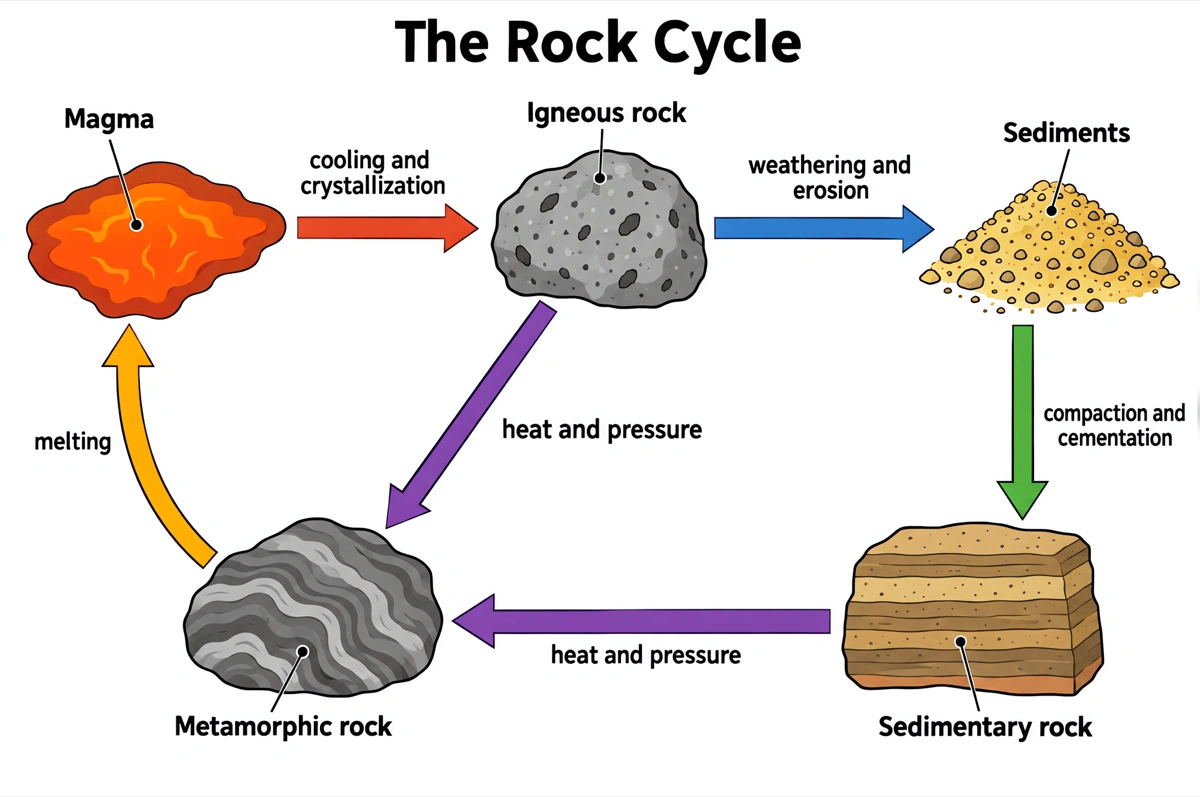
Labeled rock cycle diagram (answer key)
The three rock types, magma and sediment, with every arrow named for its process. Print it as the answer key, or hand it out as a revision sheet.
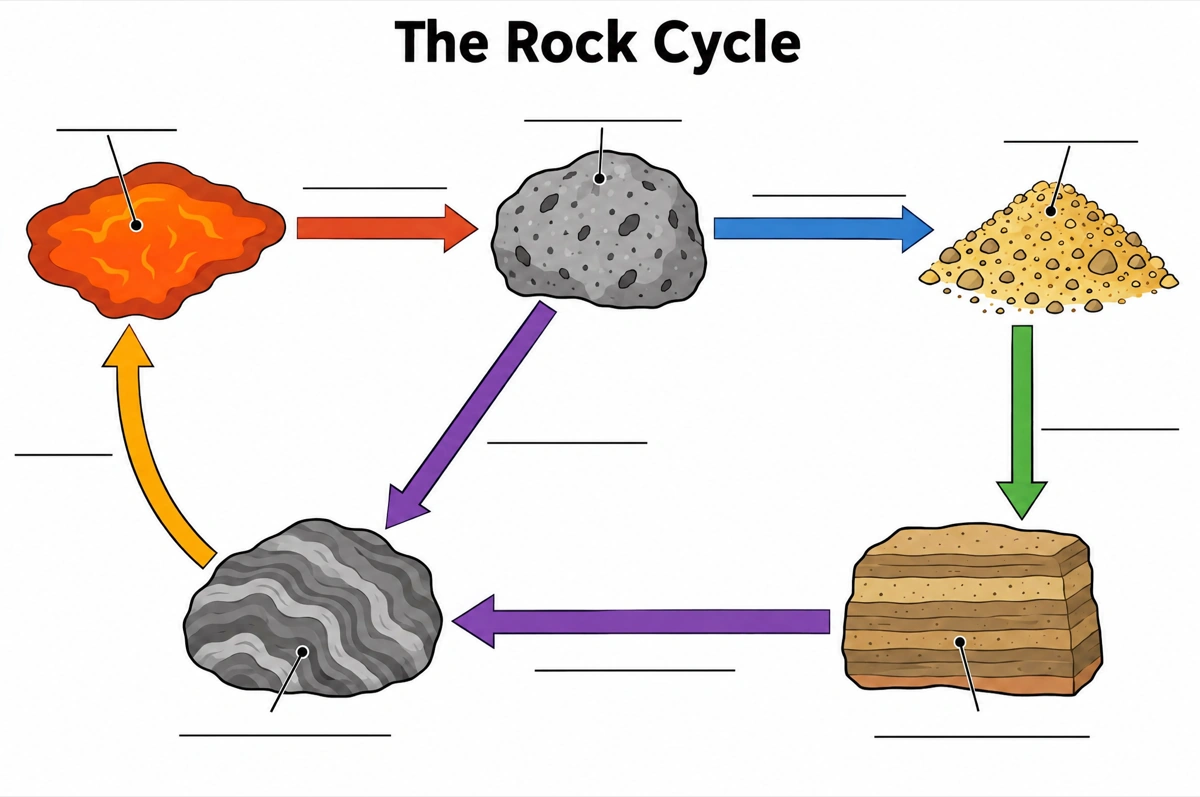
Blank rock cycle diagram to label
The same drawing with an empty answer line where every label was, ready for a worksheet, a quiz or an exam question.
What is a rock cycle diagram?
A rock cycle diagram shows how igneous, sedimentary and metamorphic rock turn into one another. Arrows name each process: melting, cooling and crystallization, weathering and erosion, deposition, compaction and cementation, and heat and pressure.
Key facts
- There are three rock types. Igneous rock forms from magma, sedimentary rock from fragments of other rocks or from minerals precipitated out of solution, and metamorphic rock from existing rock altered by heat, pressure or chemical action.
- Two energy sources drive the cycle. Earth's internal heat moves material through the mantle and crust; the water cycle, powered by the Sun, moves water, ice and air across the surface.
- Where magma cools sets the rock's texture. Magma that cools slowly underground, over centuries to millions of years, forms intrusive igneous rock such as granite; lava that cools at the surface within seconds to years forms extrusive rock such as basalt.
- Sediment becomes rock by lithification. Buried sediment is compacted, squeezing out water and air, then cemented by minerals such as calcite, quartz and hematite crystallizing in the pores between the grains.
- The loop is not one-way. Any rock type can become any other: sedimentary rock can be uplifted and eroded again, and igneous rock can be buried and metamorphosed without passing through the other stages.
How does the rock cycle diagram maker work?
Describe the diagram
Say what it is for and how deep it should go — a full labeled cycle, a simple three-rock loop, a landscape cross-section. A sentence is enough.
Pick a style
The default is a clean flat textbook plate — white background, labels on straight leader lines. Or apply watercolor, ink line art, 3D and other finishes.
Refine and export
The result opens in your workspace, where you can redraw regions, edit labels on the canvas, upscale and export in high resolution.
Processes of the rock cycle and what each one does
The processes a labeled rock cycle diagram is normally expected to name on its arrows, what each one does, and what it produces. This is the default label set unless you ask for a shorter one.
| Process | What happens | What it produces |
|---|---|---|
| Melting | Rock deep in the crust or upper mantle is heated until it partly or fully melts | Magma |
| Cooling and crystallization | Magma loses heat and its minerals crystallize — slowly underground, quickly at the surface | Intrusive or extrusive igneous rock |
| Uplift | Mountain building raises buried rock, and erosion strips away the rock above it | Rock exposed at the surface |
| Weathering | Rock is broken apart physically or altered chemically by water, air and living things | Rock and mineral fragments, and dissolved ions |
| Erosion and transport | Water, ice, wind and gravity carry the weathered material away | Moving sediment |
| Deposition | Sediment settles out in rivers, lakes, deserts and the ocean | Layers of sediment |
| Compaction and cementation | Buried sediment is squeezed, and minerals growing in the pores glue the grains together (lithification) | Sedimentary rock |
| Heat and pressure | Buried rock changes in the solid state — new minerals grow and grains may line up — without melting (metamorphism) | Metamorphic rock |
Courses differ in how finely they split the arrows. Introductory worksheets often use three — melting, weathering and erosion, heat and pressure; earth science courses separate deposition, compaction and cementation, uplift, and intrusive from extrusive rock. Name the labels you need and only those are drawn.
Igneous vs sedimentary vs metamorphic rock: what is the difference?
Igneous rock crystallizes from molten magma or lava, sedimentary rock forms from sediment compacted and cemented at or near the surface, and metamorphic rock forms when existing rock is changed by heat and pressure without melting. How a rock formed shows in its texture: interlocking crystals, grains in layers, or aligned minerals.
| Igneous | Sedimentary | Metamorphic | |
|---|---|---|---|
| How it forms | Magma or lava cools and crystallizes | Sediment is deposited, compacted and cemented | Existing rock is altered by heat, pressure and fluids |
| Where it forms | Underground (intrusive) or at the surface (extrusive) | At or near the surface, in rivers, lakes, deserts and seas | Deep in the crust, beneath mountain ranges or beside magma bodies |
| Typical texture | Interlocking crystals — coarse if cooled slowly, fine if cooled fast | Grains or fragments, often in layers | Aligned minerals (foliated) or recrystallized grains (non-foliated) |
| Fossils | None | Common | Rare, usually destroyed |
| Examples | Granite, basalt, obsidian | Sandstone, shale, limestone | Slate, schist, gneiss, marble, quartzite |
| Next step in the cycle | Weathering, or burial and metamorphism | Burial and metamorphism, or uplift and erosion | Melting into magma, or uplift and erosion |
Draw the three rock types around the loop with magma and sediment between them, then add the shortcuts: igneous rock weathered straight into sediment, sedimentary rock metamorphosed without melting, metamorphic rock uplifted and eroded. A cycle with only one-way arrows hides the point that any rock can become any other.
Where are rock cycle diagrams used?
Rock cycle diagrams are used mostly in earth science teaching — labeling worksheets, exam revision and lesson slides — and in geology courses, museum panels and field guides that explain how local rocks formed. What changes is the depth: three rock types for a first course, every process and both igneous settings for a university one.
School earth science
Labeling worksheets and revision sheets from middle school earth science (NGSS MS-ESS2-1) through high school geology and GCSE. Usually the labeled cycle, plus the same drawing blank for students to fill in.
University geology
Physical geology lectures that tie the cycle to plate tectonics: magma forming at subduction zones and spreading ridges, metamorphism beneath mountain ranges, sediment collecting in basins.
Exam revision
One-page summaries that name every arrow — which is how exam questions ask about the cycle: name the process at X, explain how a sedimentary rock becomes a metamorphic one.
Field guides and outreach
Panels for museums, parks and field trips that place the local rocks — a granite outcrop, a sandstone cliff, a marble quarry — on the cycle.
Common questions about rock cycle diagrams
What should a labeled rock cycle diagram include?
The standard set is the three rock types — igneous, sedimentary and metamorphic — plus magma and sediment, joined by arrows labeled melting, cooling and crystallization, weathering and erosion, transport and deposition, compaction and cementation, heat and pressure, and uplift. That is the default — ask for fewer labels and only those are drawn.
Can I get a blank rock cycle diagram for students to label?
Yes — view the blank version on this page free, or ask for one and every label is replaced by an empty answer line. The labeled version is the matching answer key, so the two print as a pair.
What drives the rock cycle?
Two energy sources: Earth's internal heat and the Sun. Internal heat drives mantle convection and plate tectonics, which melt, bury, squeeze and uplift rock; the Sun powers the water cycle and the winds that weather rock at the surface and carry sediment away. On the Moon, with no mantle convection, atmosphere or liquid water, the rock cycle has all but stopped.
How does a sedimentary rock become a metamorphic rock?
It is buried deeper in the crust, where rising heat and pressure change it without melting it. New minerals grow, and under directed pressure they line up into layers called foliation: shale becomes slate, then schist, then gneiss. Limestone becomes marble and sandstone becomes quartzite.
Does rock have to melt to become metamorphic?
No — metamorphism happens in the solid state. Rock hot enough to melt becomes magma, and when magma cools the result is igneous rock, not metamorphic rock. Metamorphic rock records conditions just short of melting.
What is the difference between intrusive and extrusive igneous rock?
Intrusive igneous rock cools slowly underground, so its crystals grow large enough to see; extrusive igneous rock cools quickly at the surface, so its crystals are tiny or absent. Granite is the classic intrusive rock, basalt and obsidian the classic extrusive ones.
What is the difference between weathering and erosion?
Weathering breaks rock down where it sits; erosion carries the pieces away. Weathering is physical (frost wedging, for example) or chemical (minerals dissolving or altering); erosion is done by water, ice, wind and gravity, which then deposit the sediment somewhere else.
How long does the rock cycle take?
Usually tens to hundreds of millions of years for a full loop. One open geology textbook puts a conservative estimate of about 20 million years on each major step — burial, metamorphism, uplift, erosion — though some steps are far faster: lava can harden into rock within seconds.
Can I make a simple rock cycle drawing for younger students?
Yes — ask for a simple overview and the diagram drops to the essentials: the three rock types in one loop with an arrow between each pair. Five labels or fewer usually covers a middle-school class.
How is this different from a generic AI image tool?
The subject brief is built in. Every render is instructed to follow the standard textbook drawing — each stage in its true order around a closed loop, joined by arrows that name the process — with each label spelled exactly. Check the labels against your course before printing; the canvas lets you correct any in place.
Can I use the diagrams for school, teaching or publication?
Yes — diagrams you generate are yours to use in worksheets, presentations, handouts, theses and papers. Export high-resolution raster up to 4K depending on the model.
Can I change the labels after generating?
Yes. The result opens in a canvas workspace that recognizes the diagram labels — you can edit or translate the text, move leader lines, redraw a region or recolor without regenerating the whole figure.
Sources
- The Rock Cycle — Physical Geology (Earle), section 3.1 — LibreTexts / BCcampus
- Clastic Sedimentary Rocks — Physical Geology (Earle), section 6.1 — LibreTexts / BCcampus
- Classification of Metamorphic Rocks — Physical Geology (Earle), section 7.2 — LibreTexts / BCcampus
Keep exploring
Our other diagram tools, and the guides behind them.
Draw your rock cycle diagram
From a one-line description to a labeled, printable diagram in about a minute.
Start drawing