
Calvin Cycle Diagram Maker
Describe the diagram you need and get a labeled Calvin cycle — carbon fixation by RuBisCO, reduction to G3P and regeneration of RuBP, with every molecule counted in and out. Or view the labeled and blank versions below, free.
Or start from an example
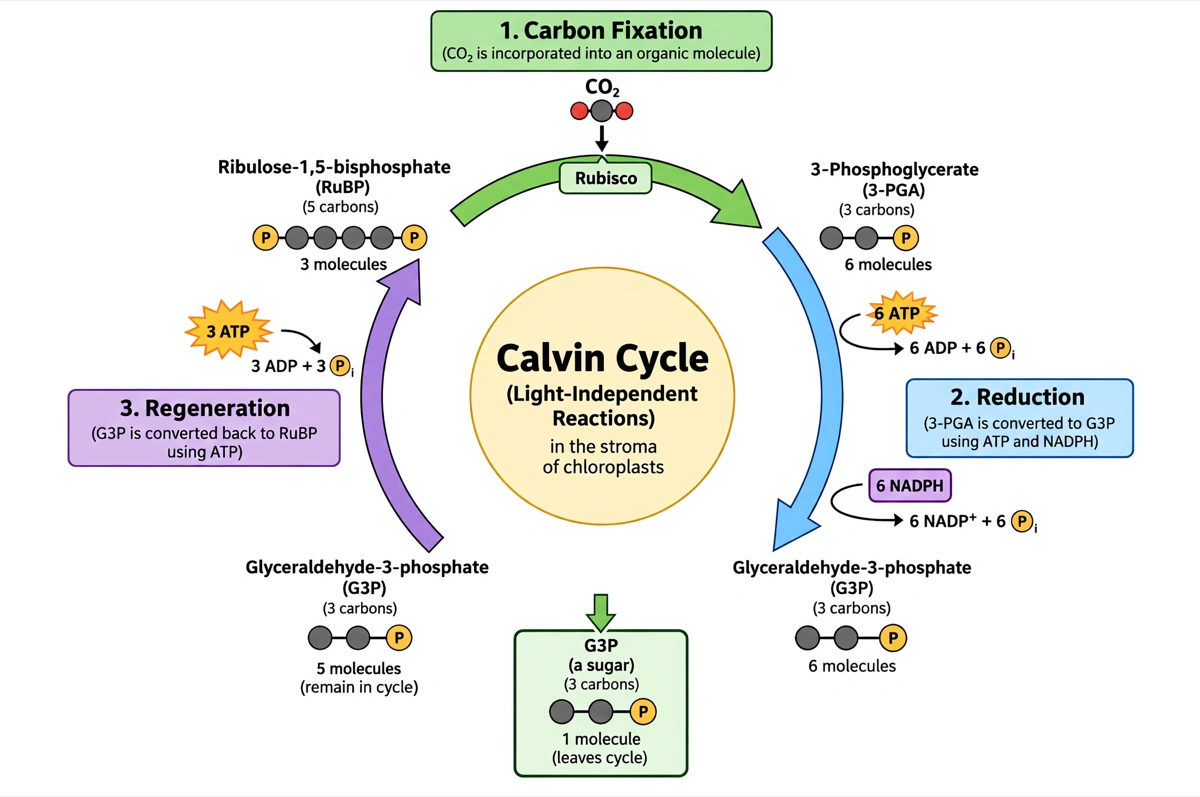
Labeled Calvin cycle diagram (answer key)
The three stages with every molecule named, from CO₂ and RuBP to G3P. Print it as the answer key, or hand it out as a revision sheet.
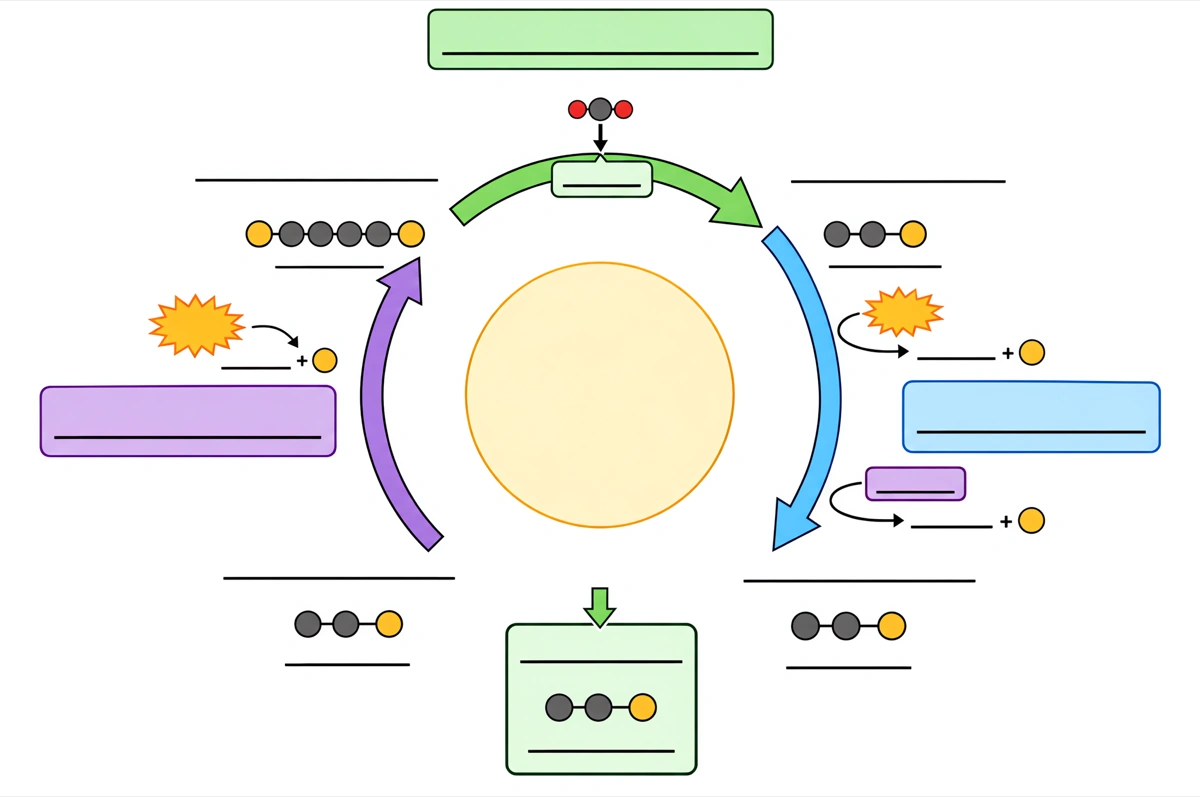
Blank Calvin cycle diagram to label
The same drawing with an empty answer line where every label was, ready for a worksheet, a quiz or an exam question.
What is a Calvin cycle diagram?
A Calvin cycle diagram shows how a chloroplast turns carbon dioxide into sugar in three stages: RuBisCO fixes CO₂ onto RuBP, ATP and NADPH reduce the product to G3P, and most of the G3P is recycled to regenerate RuBP. The cycle runs in the stroma.
Key facts
- It runs in the stroma of the chloroplast. Carbon dioxide enters the leaf through the stomata and diffuses into the stroma, where the light-independent reactions of photosynthesis take place.
- Three turns fix three CO₂ and export one G3P. RuBisCO joins 3 CO₂ to 3 RuBP, making 6 molecules of 3-PGA; 6 ATP and 6 NADPH reduce these to 6 G3P; one G3P leaves the cycle and the other five are rebuilt into 3 RuBP.
- One G3P costs 9 ATP and 6 NADPH. Six ATP go into reduction and three more into regenerating RuBP; the ADP and NADP⁺ return to the light-dependent reactions to be recharged.
- One glucose takes six turns. Each turn fixes one carbon atom, so the cycle runs six times — two G3P — for every six-carbon glucose molecule.
- “Dark reaction” is a misleading name. No step uses light directly, but the cycle runs on ATP and NADPH from the light-dependent reactions, which last only millionths of a second, so it is not independent of light and does not run only at night.
How does the Calvin cycle diagram maker work?
Describe the diagram
Say what it is for and how deep it should go — a full labeled cycle with molecule counts, a simple overview, the light-dependent reactions and the Calvin cycle side by side. A sentence is enough.
Pick a style
The default is a clean flat textbook plate — white background, labels on straight leader lines. Or apply watercolor, ink line art, 3D and other finishes.
Refine and export
The result opens in your workspace, where you can redraw regions, edit labels on the canvas, upscale and export in high resolution.
Molecules of the Calvin cycle and what each one does
The molecules and the enzyme a labeled Calvin cycle diagram is normally expected to show, what each one is, and its role in the cycle. This is the default label set unless you ask for a shorter one.
| Molecule | What it is | Role in the cycle |
|---|---|---|
| Carbon dioxide (CO₂) | The carbon source, taken in from the air through the stomata | Fixed onto RuBP in stage 1, one molecule per turn |
| RuBisCO | The enzyme ribulose-1,5-bisphosphate carboxylase/oxygenase | Catalyzes carbon fixation, joining CO₂ to RuBP |
| RuBP (ribulose-1,5-bisphosphate) | A five-carbon sugar with two phosphate groups | Takes up CO₂; rebuilt in stage 3 so the cycle can continue |
| 3-PGA (3-phosphoglycerate) | A three-carbon acid with one phosphate group | The first product: two form for every CO₂ fixed |
| ATP | The energy carrier made by the light-dependent reactions | Spent in reduction (6 per three turns) and regeneration (3 per three turns) |
| NADPH | The electron carrier made by the light-dependent reactions | Supplies the electrons that reduce 3-PGA to G3P (6 per three turns) |
| G3P (glyceraldehyde-3-phosphate) | A three-carbon sugar phosphate | The product: one in six leaves the cycle to build glucose and other compounds; five are recycled |
| ADP and NADP⁺ | The spent carriers | Return to the thylakoid membranes to be recharged by the light-dependent reactions |
Courses differ in how much detail they expect. Introductory worksheets often show CO₂ going in, sugar coming out and ATP and NADPH driving the loop; A-level and university courses name RuBisCO, RuBP, 3-PGA and G3P and count the molecules for three turns. Name the labels you need and only those are drawn.
Light-dependent reactions vs the Calvin cycle: what is the difference?
The light-dependent reactions capture light energy on the thylakoid membranes, splitting water, releasing oxygen and making ATP and NADPH; the Calvin cycle spends that ATP and NADPH in the stroma to fix carbon dioxide into sugar. The first turns light into chemical energy; the second stores it in carbon compounds.
| Light-dependent reactions | Calvin cycle | |
|---|---|---|
| Where | Thylakoid membranes | Stroma |
| Uses light directly | Yes | No, but needs their ATP and NADPH |
| Inputs | Light, water, ADP and NADP⁺ | CO₂, ATP and NADPH |
| Outputs | Oxygen, ATP and NADPH | G3P, ADP and NADP⁺ |
| Key components | Photosystem II, photosystem I, the electron transport chain and ATP synthase | RuBisCO and RuBP |
| Carbon | None is fixed | CO₂ is fixed into organic molecules |
| Other names | Light reactions | Light-independent reactions, Calvin-Benson cycle; formerly the dark reaction |
Draw the two stages as linked halves of one chloroplast: ATP and NADPH flowing from the thylakoids into the stroma, ADP and NADP⁺ flowing back. A diagram where the Calvin cycle gives off oxygen, or where the light reactions take in CO₂, is the error to check for first.
Where are Calvin cycle diagrams used?
Calvin cycle diagrams are used mostly in biology teaching — labeling worksheets, photosynthesis lessons and exam revision — and in plant biology and crop research on how plants fix carbon. What changes is the depth: CO₂ in and sugar out for a first course, every molecule counted for three turns for a university one.
School biology
Labeling worksheets and revision sheets for GCSE, A-level, AP Biology and IB, where the Calvin cycle is the second stage of photosynthesis. Usually the labeled cycle, plus the same drawing blank for students to fill in.
Photosynthesis lessons
Diagrams that join the two stages — the light-dependent reactions on the thylakoids feeding ATP and NADPH to the cycle in the stroma — and set photosynthesis against cellular respiration.
Exam revision
One-page summaries with the molecule counts — which is how exam questions ask about the cycle: how many ATP per G3P, which enzyme fixes carbon, what happens to the other five G3P.
Plant biology and research
Panels on how plants adapt carbon fixation to hot, dry places — cacti take up CO₂ at night with their stomata open, then run the cycle by day — and on improving carbon fixation in crops.
Common questions about Calvin cycle diagrams
What should a labeled Calvin cycle diagram include?
The standard set is the three stages — carbon fixation, reduction and regeneration — with CO₂, RuBisCO, RuBP, 3-PGA, ATP, ADP, NADPH, NADP⁺ and G3P, the G3P that leaves the cycle, and the molecule counts for three turns. That is the default — ask for fewer labels and only those are drawn.
Can I get a blank Calvin cycle diagram for students to label?
Yes — view the blank version on this page free, or ask for one and every label is replaced by an empty answer line. The labeled version is the matching answer key, so the two print as a pair.
What are the three stages of the Calvin cycle?
Carbon fixation, reduction and regeneration. In fixation RuBisCO joins CO₂ to RuBP, giving 3-PGA; in reduction ATP and NADPH turn 3-PGA into G3P; in regeneration most of the G3P is rebuilt into RuBP, using more ATP, so the cycle can take in the next CO₂.
Where does the Calvin cycle take place?
In the stroma of the chloroplast, the fluid around the thylakoids. The light-dependent reactions happen on the thylakoid membranes, so the ATP and NADPH they make are released right where the cycle needs them.
What are the inputs and outputs of the Calvin cycle?
For three turns, 3 CO₂, 9 ATP and 6 NADPH go in; one G3P, 9 ADP and 6 NADP⁺ come out. The ADP and NADP⁺ go back to the light-dependent reactions to be recharged; the G3P is used to build glucose and other compounds.
How many turns of the Calvin cycle make one glucose?
Six. Each turn fixes one carbon atom, so three turns make one three-carbon G3P and six turns make the two G3P behind one six-carbon glucose — at a cost of 18 ATP and 12 NADPH.
What does RuBisCO do?
RuBisCO is the enzyme that fixes carbon: it joins each CO₂ to a molecule of RuBP, and each reaction gives two molecules of 3-PGA. Its full name is ribulose-1,5-bisphosphate carboxylase/oxygenase, and it works in the stroma on the RuBP the cycle keeps regenerating.
Why is the Calvin cycle called light-independent?
Because none of its steps uses light directly — but it still depends on light. It runs on the ATP and NADPH made by the light-dependent reactions, which last only millionths of a second. That is why the old name, “dark reaction”, misleads: the cycle does not run only at night.
Can I make a simple Calvin cycle drawing for younger students?
Yes — ask for a simple overview and the diagram drops to the essentials: carbon dioxide going in, ATP and NADPH driving the loop, sugar coming out and the starting molecule rebuilt. Five labels or fewer usually covers a middle-school class.
How is this different from a generic AI image tool?
The subject brief is built in. Every render is instructed to follow the standard textbook drawing — each stage in its true order around a closed loop, joined by arrows that name what goes in and out — with each label spelled exactly. Check the labels against your course before printing; the canvas lets you correct any in place.
Can I use the diagrams for school, teaching or publication?
Yes — diagrams you generate are yours to use in worksheets, presentations, handouts, theses and papers. Export high-resolution raster up to 4K depending on the model.
Can I change the labels after generating?
Yes. The result opens in a canvas workspace that recognizes the diagram labels — you can edit or translate the text, move leader lines, redraw a region or recolor without regenerating the whole figure.
Keep exploring
Our other diagram tools, and the guides behind them.
Tools
Draw your Calvin cycle diagram
From a one-line description to a labeled, printable diagram in about a minute.
Start drawing