
Krebs Cycle Diagram Maker
Generate labeled Krebs cycle diagrams: the eight-step citric acid cycle loop with its intermediates and enzymes, a simple school version, carbon-counting and glycolysis-to-TCA figures. Used in biology worksheets, lecture slides and papers.
Krebs cycle diagram examples
Each card is what its prompt above actually drew: the complete loop with eight enzymes and carbon counts, a high-school version with intermediates and products only, the carbons counted bead by bead, and glycolysis feeding two turns of the cycle. Clicking a card puts that prompt in the box for you to change.
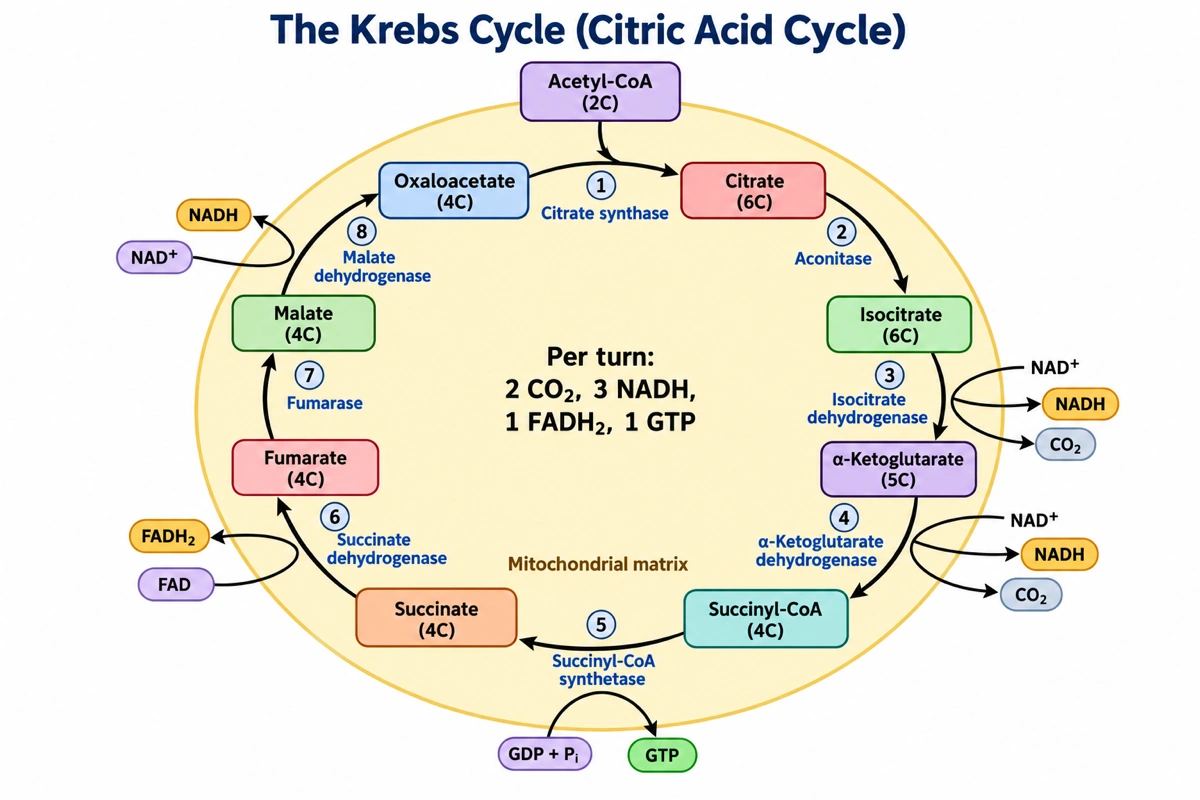
Krebs cycle diagram explained: one turn in eight steps
Start at the top, where acetyl-CoA joins oxaloacetate, and follow the numbered arrows clockwise through the mitochondrial matrix.
- 1
1–2 Citrate synthase, aconitase
Acetyl-CoA (2C) joins oxaloacetate (4C) to make citrate (6C), which is rearranged into isocitrate.
- 2
3–4 Two oxidative decarboxylations
A CO₂ leaves to give α-ketoglutarate (5C), another to give succinyl-CoA (4C), each with one NADH.
- 3
5–6 GTP, then FADH₂
Succinyl-CoA synthetase makes the turn's only GTP; succinate dehydrogenase reduces FAD to FADH₂.
- 4
7–8 Back to oxaloacetate
Fumarase adds water to make malate; malate dehydrogenase makes the third NADH and rebuilds oxaloacetate.
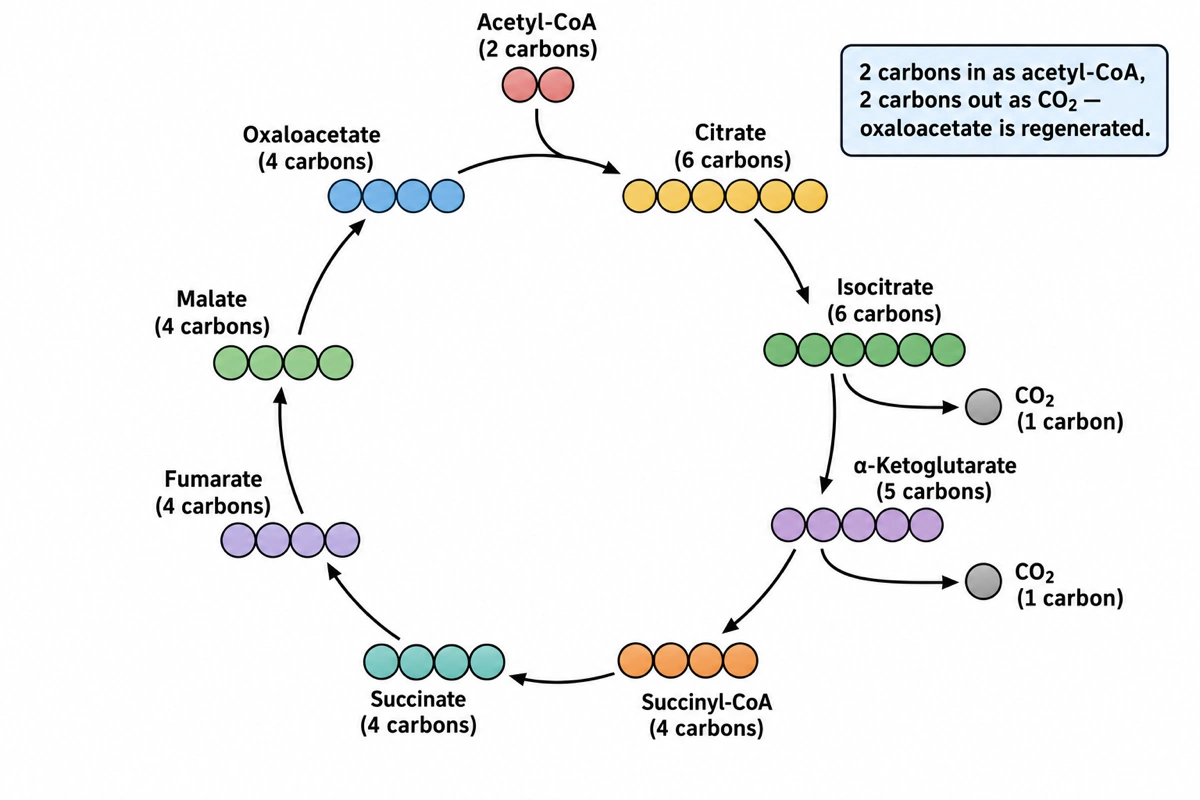
Counting carbons around the citric acid cycle: 2 in, 2 out
The same loop with every intermediate drawn as a chain of carbon beads, so the two decarboxylations show up as beads leaving.
- 1
6C: citrate and isocitrate
Acetyl-CoA's 2 carbons join oxaloacetate's 4; citrate turns into isocitrate with all 6 still there.
- 2
6 → 5 → 4: two CO₂ leave
One carbon leaves as CO₂ to give α-ketoglutarate (5C), a second to give succinyl-CoA (4C).
- 3
4C all the way back
Succinate, fumarate and malate keep four carbons; the last steps only oxidize them back to oxaloacetate.
Krebs, citric acid and TCA cycle diagrams, simple to detailed
Three names, one pathway — and a figure that ranges from five labels on a school worksheet to skeletal formulas in a biochemistry exam. Say which of these your course expects.
Krebs cycle diagram simple
The loop with names and products only: acetyl-CoA in, the eight intermediates in order, and CO₂, NADH, FADH₂ and ATP leaving as side arrows, with no enzymes. Some GCSE and AP sheets shrink it further to four boxes, a 6-carbon compound, a 5-carbon compound, a 4-carbon compound and oxaloacetate, which is enough to show the two CO₂ steps.
Krebs cycle diagram with enzymes
Each arrow named after the enzyme that drives it: citrate synthase, aconitase, isocitrate dehydrogenase, α-ketoglutarate dehydrogenase, succinyl-CoA synthetase, succinate dehydrogenase, fumarase, malate dehydrogenase. Mark the three dehydrogenases that make NADH and point out that succinate dehydrogenase is the only one built into the inner membrane, where it doubles as complex II.
TCA cycle diagram with structures
The biochemistry version: every intermediate as a skeletal formula, so students can see citrate and isocitrate carry three carboxyl groups (the tricarboxylic acid that names the cycle), α-ketoglutarate its keto group, and succinyl-CoA its thioester. Ask for the bond that breaks at each decarboxylation to be highlighted.
Citric acid cycle diagram counting carbons
Carbon counts written on each intermediate, or drawn as beads: 2 join 4 to make 6, one CO₂ takes it to 5, a second CO₂ to 4, and four carbons go round to oxaloacetate. A good trap to label: the two CO₂ that leave a turn are not the two carbons that acetyl-CoA brought in; those leave on later turns.
Glycolysis and Krebs cycle diagram
The respiration route up to the cycle: glucose to two pyruvate in the cytoplasm, pyruvate into the mitochondrion, pyruvate dehydrogenase making acetyl-CoA with one CO₂ and one NADH each, then two turns of the cycle. Totals for one glucose at this point: 4 ATP or GTP, 10 NADH, 2 FADH₂, 6 CO₂.
Krebs cycle regulation diagram
The loop with its control points drawn as inhibition bars and activation arrows: citrate synthase slowed by ATP, NADH and succinyl-CoA; isocitrate dehydrogenase, the main brake, slowed by ATP and NADH and sped up by ADP and Ca²⁺; α-ketoglutarate dehydrogenase slowed by NADH and succinyl-CoA. For medical biochemistry and the energy-state questions that go with it.
Electron transport chain diagram
Not part of the Krebs cycle but the step it feeds, and a separate figure: complexes I to IV in the inner mitochondrial membrane, ubiquinone and cytochrome c carrying electrons between them, protons pumped into the intermembrane space and ATP synthase letting them back. NADH hands its electrons to complex I, FADH₂ stays on complex II, and oxygen takes them at complex IV. Ask for it by name.
The 8 steps of the Krebs cycle
Read clockwise from the top of the loop. The third column is what a labeled diagram puts on the side arrow of each step.
| Step and enzyme | Reaction | What leaves or is made |
|---|---|---|
| 1 Citrate synthase | Acetyl-CoA (2C) + oxaloacetate (4C) → citrate (6C) | CoA-SH is released; the step is irreversible |
| 2 Aconitase | Citrate → isocitrate, by way of cis-aconitate | Nothing leaves; the hydroxyl group is moved |
| 3 Isocitrate dehydrogenase | Isocitrate (6C) → α-ketoglutarate (5C) | CO₂ and the first NADH; the main control point |
| 4 α-Ketoglutarate dehydrogenase | α-Ketoglutarate (5C) → succinyl-CoA (4C) | The second CO₂ and the second NADH |
| 5 Succinyl-CoA synthetase | Succinyl-CoA → succinate | GTP (or ATP) by substrate-level phosphorylation; CoA-SH released |
| 6 Succinate dehydrogenase | Succinate → fumarate | FADH₂; the enzyme is complex II of the electron transport chain |
| 7 Fumarase | Fumarate + H₂O → malate | Nothing leaves; water is added |
| 8 Malate dehydrogenase | Malate → oxaloacetate | The third NADH; oxaloacetate is ready for the next acetyl-CoA |
Some textbooks count nine or ten steps. They draw cis-aconitate as its own intermediate, or start with the pyruvate dehydrogenase step that makes acetyl-CoA, which is not part of the cycle itself. Older books call step 5's enzyme succinic thiokinase, and heart and muscle make ATP at that step while liver makes GTP. Say which names and how many steps your course uses.
What is the Krebs cycle?
The Krebs cycle, also called the citric acid cycle or the tricarboxylic acid (TCA) cycle, is the eight-step loop in the mitochondrial matrix that oxidizes the two-carbon acetyl group of acetyl-CoA to two CO₂, stores the energy as 3 NADH, 1 FADH₂ and 1 GTP or ATP per turn, and ends by regenerating the oxaloacetate it started with. A Krebs cycle diagram draws that loop with its intermediates in order and its products leaving at the steps that make them.
Key facts
- It runs in the mitochondrial matrix. All of its enzymes are dissolved in the matrix except succinate dehydrogenase, which sits in the inner membrane; in bacteria the cycle runs in the cytoplasm.
- Each turn takes in 2 carbons and gives out 2 CO₂. Acetyl-CoA (2C) joins oxaloacetate (4C) to make citrate (6C); two decarboxylations bring it back to four carbons and the rest of the loop rebuilds oxaloacetate.
- Most of the energy leaves as NADH and FADH₂, not ATP. One turn makes 3 NADH, 1 FADH₂ and only 1 GTP or ATP directly; the electron carriers are worth about 9 more ATP once the electron transport chain uses them.
- The cycle turns twice for every glucose. Glycolysis splits glucose into two pyruvate, each becomes one acetyl-CoA, so per glucose the cycle gives 4 CO₂, 6 NADH, 2 FADH₂ and 2 GTP or ATP.
- It was worked out by Hans Krebs in the 1930s in pigeon flight muscle. The name citric acid cycle comes from its first product, and TCA cycle from citrate and isocitrate being tricarboxylic acids.
Krebs cycle vs Calvin cycle
The Krebs cycle takes carbon apart and the Calvin cycle puts it together: the Krebs cycle oxidizes acetyl groups to CO₂ in the mitochondria and fills NAD⁺ and FAD with electrons, while the Calvin cycle fixes CO₂ into sugar in the chloroplast and spends ATP and NADPH to do it. Both are closed loops that rebuild their starting molecule, which is why they are compared.
| Krebs cycle | Calvin cycle | |
|---|---|---|
| Where | Mitochondrial matrix | Chloroplast stroma |
| Part of | Cellular respiration (breaks molecules down) | Photosynthesis (builds sugar) |
| CO₂ | Released, 2 per turn | Taken in, 1 per turn, by RuBisCO |
| Electron carriers | NAD⁺ and FAD reduced to NADH and FADH₂ | NADPH oxidized to NADP⁺ |
| ATP | 1 GTP or ATP made per turn | 3 ATP used per CO₂ fixed |
| Regenerated molecule | Oxaloacetate (4C) | RuBP (5C) |
On a diagram, follow the CO₂ arrows: in the Krebs cycle they point out of the loop, in the Calvin cycle into it. Plants run both, the Calvin cycle in chloroplasts by day and the Krebs cycle in mitochondria all the time.
Questions about the Krebs cycle
Is a Krebs cycle diagram the same as a citric acid cycle diagram?
Yes. Krebs cycle, citric acid cycle and TCA (tricarboxylic acid) cycle are three names for one pathway, so the three diagrams show the same loop. Biology courses tend to say Krebs cycle, biochemistry courses citric acid or TCA cycle. Use whichever name your course uses in the title; the intermediates and products do not change.
Where does the Krebs cycle take place?
In the mitochondrial matrix, the space inside the inner mitochondrial membrane. The one exception is succinate dehydrogenase (step 6), which is anchored in the inner membrane itself. In bacteria, which have no mitochondria, the cycle runs in the cytoplasm.
What are the 8 steps of the Krebs cycle?
1 acetyl-CoA joins oxaloacetate to make citrate; 2 citrate becomes isocitrate; 3 isocitrate becomes α-ketoglutarate, releasing CO₂ and NADH; 4 α-ketoglutarate becomes succinyl-CoA, releasing CO₂ and NADH; 5 succinyl-CoA becomes succinate, making GTP or ATP; 6 succinate becomes fumarate, making FADH₂; 7 fumarate takes up water to become malate; 8 malate becomes oxaloacetate, making NADH.
What are the reactants and products of the Krebs cycle?
Per turn it takes in 1 acetyl-CoA, 3 NAD⁺, 1 FAD, 1 GDP (or ADP) with phosphate and 2 H₂O, and gives out 2 CO₂, 3 NADH, 1 FADH₂, 1 GTP (or ATP) and CoA. Oxaloacetate is used at step 1 and made again at step 8, so it is neither a reactant nor a product overall.
How many ATP does the Krebs cycle produce?
Directly, one GTP or ATP per turn, so two per glucose. Counting the 3 NADH and 1 FADH₂ at about 2.5 and 1.5 ATP each in the electron transport chain, one turn is worth about 10 ATP, or about 20 per glucose.
Does the Krebs cycle need oxygen?
It uses no oxygen itself, but it stops without it, so it counts as aerobic. The cycle needs a steady supply of NAD⁺ and FAD, and those are only regenerated when the electron transport chain can pass electrons to oxygen. Without oxygen, NADH builds up and the dehydrogenase steps halt.
Why does the Krebs cycle turn twice per glucose?
Because one glucose gives two pyruvate in glycolysis, and each pyruvate becomes one acetyl-CoA. Each acetyl-CoA drives one turn, so per glucose every product doubles: 4 CO₂, 6 NADH, 2 FADH₂ and 2 GTP or ATP.
What happens to pyruvate before the Krebs cycle?
It is carried into the mitochondrial matrix and converted to acetyl-CoA by the pyruvate dehydrogenase complex, releasing one CO₂ and one NADH. This link reaction is not one of the eight steps, but most diagrams draw it as the arrow coming into the top of the loop.
Is there a mnemonic for the Krebs cycle intermediates?
A common one is "Citrate Is Krebs' Starting Substrate For Making Oxaloacetate": citrate, isocitrate, α-ketoglutarate, succinyl-CoA, succinate, fumarate, malate, oxaloacetate. The initials follow the loop clockwise from the top, so it also gives the order for labeling a diagram.
Which enzymes control the Krebs cycle?
Citrate synthase, isocitrate dehydrogenase and α-ketoglutarate dehydrogenase, the three steps with large energy drops. High ATP and NADH slow them down; calcium speeds both dehydrogenases up and ADP speeds isocitrate dehydrogenase, so the cycle runs faster when a muscle is working.
How is the Krebs cycle different from the electron transport chain?
The Krebs cycle strips electrons from acetyl groups and loads them onto NAD⁺ and FAD; the electron transport chain, in the inner membrane, takes them from NADH and FADH₂, passes them to oxygen and uses the energy to make most of the cell's ATP. They are drawn as separate figures, the cycle in the matrix and the chain across the membrane.
Keep exploring
Our other diagram tools, and the guides behind them.
Tools
Draw your Krebs cycle diagram
From a one-line request to the full loop, its enzymes and its products, labeled the way your course names them.
Start drawing