
Dichotomous Key Maker
Describe the organisms you want to sort and get a correct dichotomous key — numbered couplets of two contrasting, observable statements, leads 1a and 1b, and every path ending in a named organism, as a branching tree or a numbered list. Or view the labeled and blank versions below, free.
Or start from an example
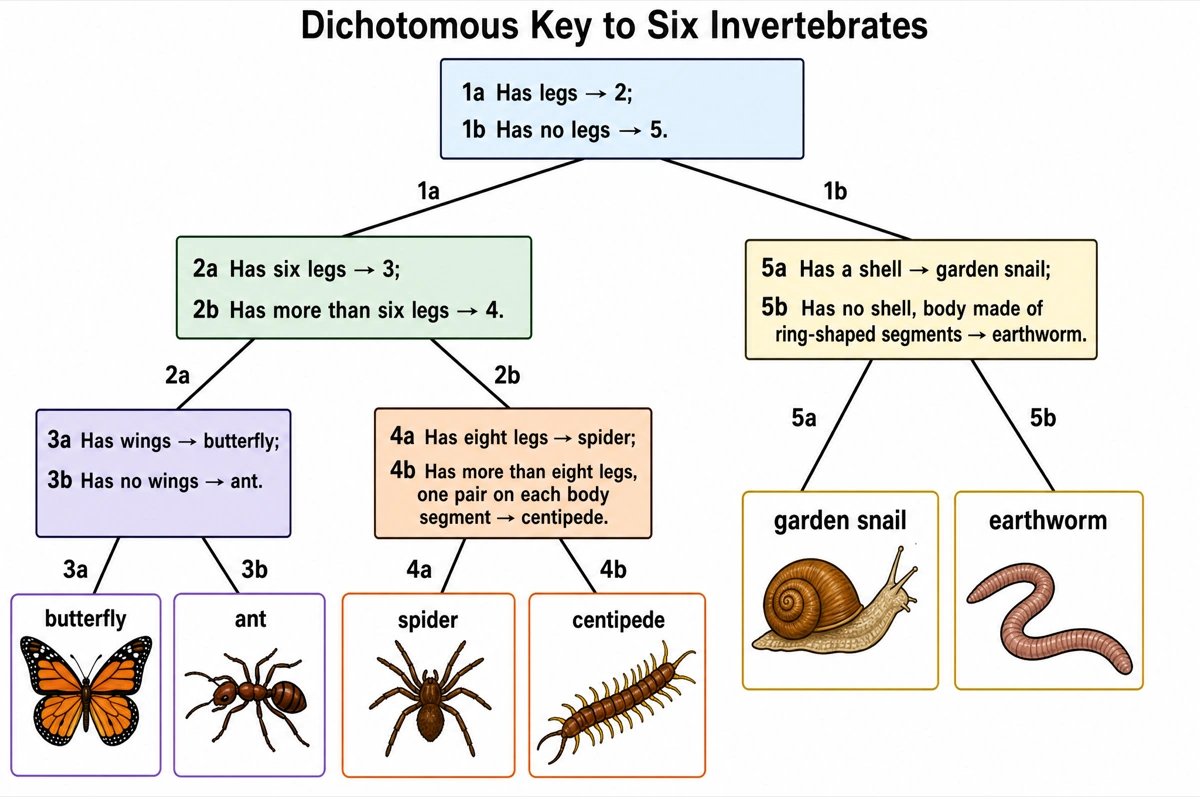
Dichotomous key example (answer key)
Six common invertebrates sorted by five couplets — legs, number of legs, wings, shell — with every lead numbered and every branch ending in a name. Print it as the answer key or use it as a model key.
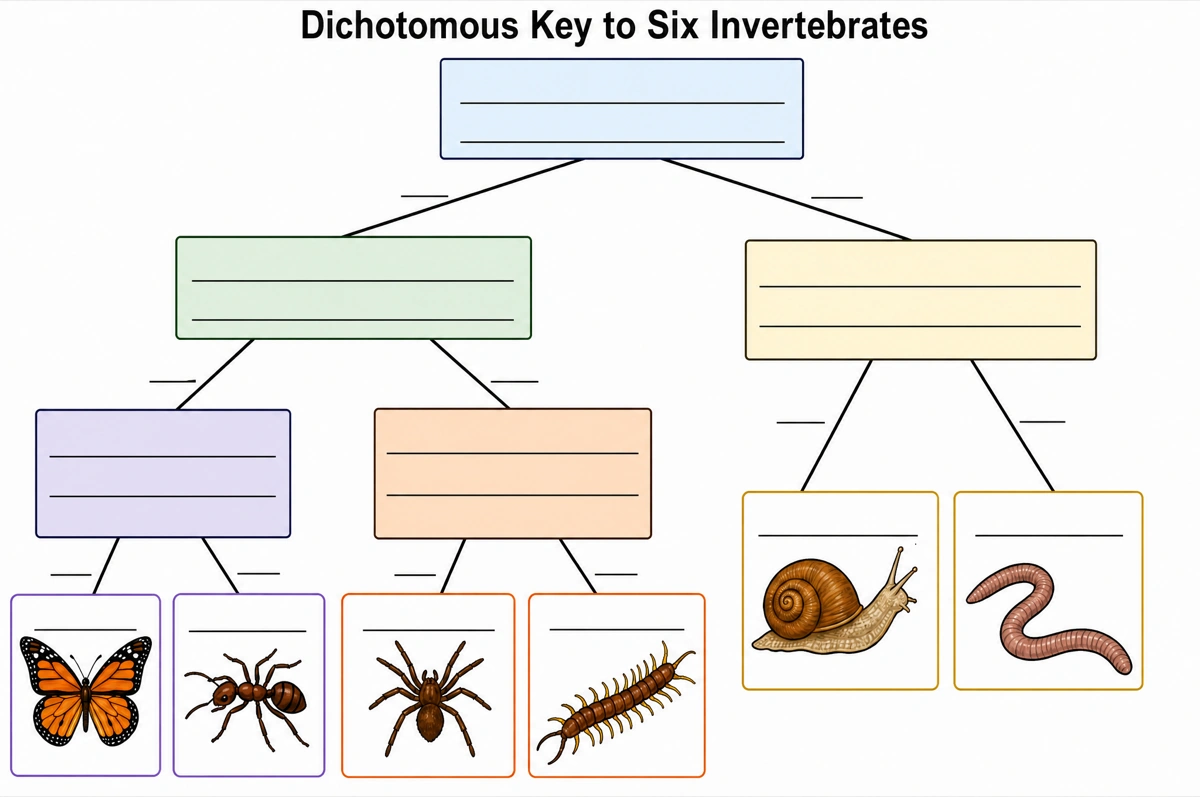
Blank dichotomous key template to fill in
The same tree with an empty answer line in place of every statement and name, ready for students to write the couplets and name each organism.
What is a dichotomous key?
A dichotomous key is an identification tool that sorts organisms through a series of choices between two contrasting statements, called couplets; each choice leads either to the next couplet or to the name of the organism. “Dichotomous” means dividing in two, and a well-built key ends every path in exactly one named organism or group.
Key facts
- A couplet is two statements about the same character. “Leaves are needles” against “leaves are broad and flat” is a couplet; “leaves are needles” against “bark is rough” is not, because a specimen could match both or neither.
- The two leads must be mutually exclusive. Every specimen fits exactly one lead of each couplet, so the path through the key is never ambiguous.
- Leads are numbered in pairs. Couplet 1 has the leads 1a and 1b (some floras write 1 and 1′), and each lead ends either with the number of the next couplet or with a name.
- The characters must be visible on the specimen. Number of legs, leaf shape or the presence of a shell work; habitat, behavior or diet do not, because they cannot be checked on the organism in front of you.
- It comes in two layouts. A branching tree, like a flowchart, is easiest to follow in class; a numbered couplet list — bracketed or indented — is how field guides and floras print keys, and it fits many more organisms on a page.
How does the dichotomous key maker work?
Name the organisms
List the organisms or specimens the key should sort — or describe them, a line each with the features you can see. Say whether you want a branching tree or a numbered list, and paste your own couplets if you already have them.
Pick a style
The default is a clean textbook plate — white background, numbered couplets, a small drawing at each branch end. Or apply ink line art, watercolor, chalkboard and other finishes.
Refine and export
The result opens in your workspace, where you can reword a lead on the canvas, redraw a region, upscale and export in high resolution.
Parts of a dichotomous key and how to write each one
The parts every dichotomous key is built from, what each one is, and the rule that keeps it usable. These are the rules every key drawn here follows.
| Part | What it is | How to write it |
|---|---|---|
| Couplet | One numbered step of the key: a pair of contrasting statements | About one character only, with exactly two options |
| Lead | One of the two statements in a couplet | Start both leads the same way: “Leaves simple” / “Leaves compound” |
| Character | The feature a couplet compares | Something visible on the specimen: body parts, counts, shapes, arrangement |
| Character state | The form the character takes | Contrasting and exact: “six legs” / “eight legs”, measurements rather than “large” and “small” |
| Go-to number | The couplet a lead sends you to | Always a later couplet, so the key never loops back |
| Named organism (taxon) | The name a path ends on | One named species or group at the end of each path |
| Number of couplets | Set by the number of organisms | A key to n organisms has n − 1 couplets: six organisms, five couplets |
| Layout | How the couplets are arranged on the page | A branching tree for teaching; a bracketed or indented numbered list for field guides |
Courses differ in how they number leads. Many school keys use 1a and 1b; botanical floras often use 1 and 1′, or indent the second lead under the first. Name the style your course uses and the key is drawn that way.
Dichotomous key vs cladogram: what is the difference?
A dichotomous key identifies an organism from features you can see; a cladogram shows how organisms are related by descent from common ancestors. Both branch in twos, but the groups in a key need not be related at all — “has a shell” puts a snail beside a turtle.
| Dichotomous key | Cladogram | |
|---|---|---|
| Purpose | Identify an unknown organism | Show evolutionary relationships |
| Branch points | Couplets of two contrasting statements | Common ancestors, marked by shared derived traits |
| Characters used | Any visible feature that splits the list cleanly | Traits inherited from a common ancestor |
| Groups | Need not be related | Clades: an ancestor and all its descendants |
| Read | From the top, one choice at a time | From the root out to the tips |
| Ends in | A named organism or group | The organisms being compared |
Use a key to name a specimen and a cladogram to explain how it is related to others. Grouping a snail with a turtle because both have shells is fine in a key and wrong in a cladogram.
Where are dichotomous keys used?
Dichotomous keys are used wherever organisms have to be named from what they look like — biology classes, field work, microbiology labs and published field guides. What changes is the scale: a handful of classroom animals, or every species in a genus.
School biology
Classification lessons and worksheets in middle-school life science, GCSE, AP Biology and IB, where students both use a key and write their own.
Field work and ecology
Naming the invertebrates from a pond dip or a pitfall trap, or the trees on a nature walk, with a key printed for the site.
Microbiology labs
Identifying an unknown bacterium from its Gram stain, cell shape and biochemical test results, one couplet per test.
Field guides and taxonomy
Floras, field guides and taxonomic papers publish keys to the species of a region or a genus, usually as a numbered couplet list.
Common questions about dichotomous keys
How do you make a dichotomous key?
List the organisms, pick one visible character that splits them into two groups of about the same size, and write it as two contrasting statements — that is couplet 1. Repeat inside each group, numbering each new couplet, until every group holds one organism and each path ends in its name. Then test the key by running every specimen through it.
What makes a good couplet?
Two statements about the same character that cannot both be true and that anyone can check on the specimen. Word them positively (“wings present” / “wings absent”, not “not winged”), start both the same way, and prefer counts and measurements to “large” and “small”.
Can I get a blank dichotomous key template?
Yes — view the blank version on this page free, or ask for one and every statement and name is replaced by an empty answer line. The labeled version is the matching answer key, so the two print as a pair.
Should I draw a branching tree or a numbered list?
A tree for teaching, a list for anything long. The branching tree shows every path at once and suits a handful of organisms; the numbered couplet list — 1a, 1b, 2a, 2b, each ending in “go to” a number or a name — is the form field guides use and fits dozens of organisms. Ask for either.
How many couplets does a dichotomous key need?
One fewer than the number of organisms. Every couplet splits one group into two, so a key to six organisms has five couplets and a key to twenty has nineteen, however they are arranged.
What do 1a and 1b mean in a dichotomous key?
They are the two leads of couplet 1. You read both, choose the one that fits your specimen, and follow it — either to the couplet number it gives (“go to 2”) or to the name it ends in.
Can a key have three choices at one step?
Then it is no longer dichotomous. A key with three or more choices at a step is polytomous, and a multi-access key lets you use the characters in any order. A dichotomous key always offers exactly two.
Can I make a key for bacteria, rocks or anything else?
Yes — a key can sort anything with features you can check. Bacteria by Gram stain, shape and test results; minerals by hardness and streak; leaves by shape and arrangement. Describe what you are sorting and the key is drawn for it.
Does the maker write the couplets for me?
Yes, if you only name the organisms — it drafts a key from their standard textbook features. Check each couplet against your own specimens before handing it out, or give your own couplets and they are drawn exactly as written.
How is this different from a generic AI image tool or a flowchart template?
The rules of a key are built in. Every render is instructed to pair two contrasting statements about one character at each couplet, number the leads and end every branch in a named organism — a template gives you boxes and leaves the biology to you. The canvas lets you correct any lead in place.
Can I use the keys for school, teaching or publication?
Yes — keys you generate are yours to use in worksheets, presentations, field guides, theses and papers. Export high-resolution raster up to 4K depending on the model.
Can I change the wording after generating?
Yes. The result opens in a canvas workspace that recognizes the text in the key — you can reword a lead, rename an organism, translate the key, redraw a region or recolor without regenerating the whole figure.
Sources
Keep exploring
Our other diagram tools, and the guides behind them.

Make your dichotomous key
From a list of organisms to a numbered, printable key in about a minute.
Start making