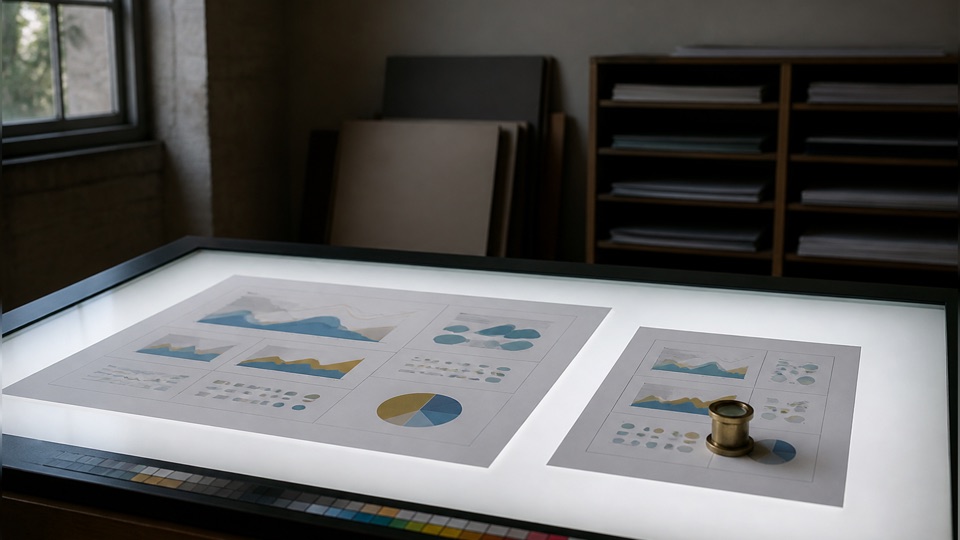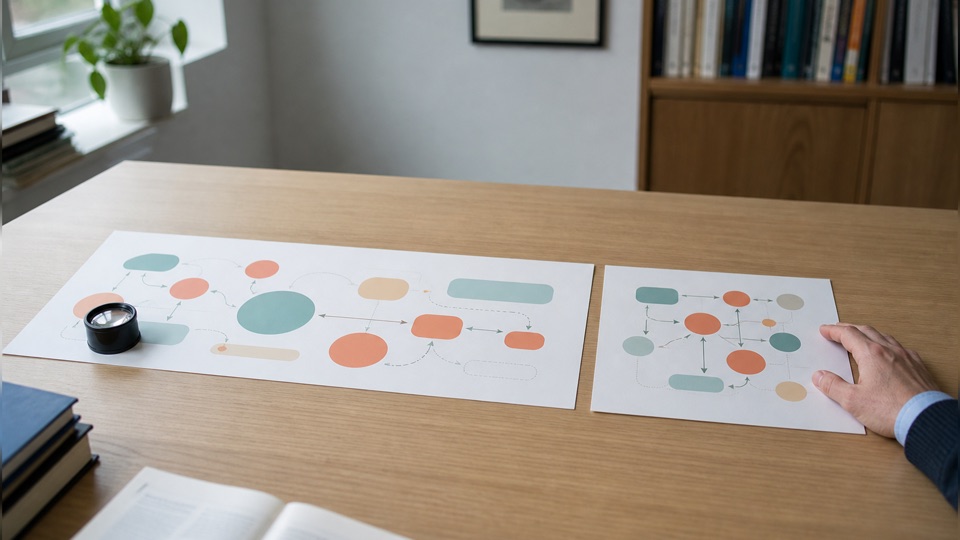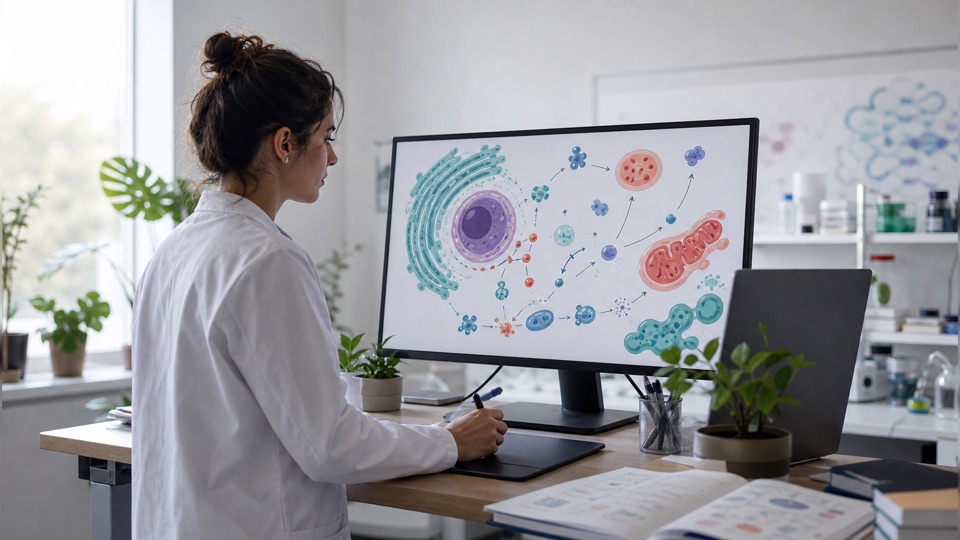
A reader asked us whether figures made on this site can go straight into an SCI journal submission. The honest answer is longer than yes or no, so here it is: what fourteen publishers and three ethics bodies say, in plain language, with the exact wording they want in your legend.
The question arrived in our inbox in one line: can figures made with AI on this site be used in a submission to an SCI journal? It deserves a straight answer, and the straight answer is that it depends on two things. What the figure shows, and where you are sending it. Everything below is those two things worked out, from the publishers’ own pages, read on 21 September 2026.
One warning before the table. These policies are the fastest-moving part of any author guide. Elsevier’s page now has a three-category system that did not exist two years ago; Nature Portfolio’s page has been rewritten into a risk framework. Use this article to know what to look for, then open the policy page for your target journal on the day you submit.
Which publishers allow AI-generated figures?
The table reads across fourteen publishers. "Explanatory figures" means diagrams that show an idea rather than a measurement: workflows, pathway schematics, timelines, conceptual illustrations. "Data images" means anything that is itself evidence: micrographs, blots, gels, scans, photographs of patients or specimens. Plots drawn from your own numbers sit in between and get their own column where a publisher separates them out.
| Publisher | Explanatory figures (diagrams, schematics) | Data images (micrographs, blots, scans) | Where to disclose | Source document |
|---|---|---|---|---|
| Elsevier | Permitted. Author must verify accuracy; graphical abstracts may not use general-purpose AI image tools | Not permitted, including brightness, contrast or colour-balance changes | Figure caption (tool, version, how used) + the article’s AI disclosure statement; data visualisations in Methods | Generative AI policies for journals |
| Cell Press | Permitted, in line with Elsevier policy | Not permitted; cover art also not permitted without editorial exception | Figure legend + general AI disclosure statement | Journal policies |
| Nature Portfolio | Not stated. The policy is a green/amber/red risk framework; diagrams are not named in any tier | Only "creating photorealistic images (deepfakes)" is listed as not permitted; image manipulation rules apply separately | Disclosure expected across all tiers | Editorial policies: AI |
| Science journals | Not permitted without explicit permission from the editors | Not permitted without explicit permission from the editors | Cover letter at submission; Methods or acknowledgments | Editorial Policies |
| Wiley | Permitted for illustrations and data visualisations, with disclosure and verification | AI-edited photographs not permitted; "factual and evidential images" not permitted | At submission and in the manuscript; caption example provided | AI Guidelines for Researchers |
| Taylor & Francis | Permitted for conceptual illustrations, flow diagrams and data visualisations | Not permitted for creation or manipulation of research or clinical outputs | Not specified on the policy page beyond "transparency" | AI Policy |
| JAMA Network | Clinical illustrations created by AI not permitted unless part of the research design | Clinical images created or manipulated by AI not permitted unless part of the research design | Acknowledgment section: tool, version, manufacturer, dates, what it did | Instructions for Authors |
| BMJ | Considered, with transparent description; editors judge suitability | Same policy applies to photographs and images; image-integrity rules unchanged | Contributor section; Methods if used in the research | AI use policy |
| IEEE | Permitted with disclosure | Not separately addressed | Acknowledgments: the AI system and the sections it produced | Submission and Peer Review Policies |
| Frontiers | Permitted; figures must be checked against the data presented | Falls under image-manipulation rules: no features added, removed or altered | Acknowledgments and Methods: name, version, model, source; prompts encouraged as supplementary files | Policies and publication ethics |
| Sage | Permitted with disclosure ("representative illustrations or infographics") | "Generated images presented as unique or novel research images" is listed as inappropriate use | Methods or acknowledgments; disclosed at submission | Artificial intelligence policy |
| MDPI | Permitted with declaration | Falls under image-manipulation rules | Declared at submission; details in Materials and Methods; tool in Acknowledgments | Research and Publication Ethics |
| PLOS | Not separately addressed; all AI contributions must be reported | Image-manipulation rules apply | A dedicated section of the Methods (or Acknowledgements) | Ethical Publishing Practice |
| ACS Publications | Not verified — the author guidelines page could not be read at the time of writing | Not verified | Not verified | — |
Two patterns fall out of that table. First, no publisher lets AI touch a data image. Not to generate one, not to tidy one. Second, most publishers now let you use AI for a diagram, as long as you say so and take responsibility for what it shows. The strict outliers are Science, which wants permission first, and JAMA, which says no to AI clinical illustrations outright.
Diagram or data? The one question that decides your case
If you remember one thing from this page, make it this distinction. Elsevier spells it out most clearly, and its wording is worth having in your head because Cell Press journals apply the same three boxes.
Explanatory images illustrate concepts, processes or relationships. Flow charts, decision trees, timelines, schematic conceptual illustrations, experimental workflow diagrams. Elsevier says authors may use AI tools to support the creation of these, with disclosure in the caption and in the article’s AI statement.
Research and data images present research data or results. Elsevier splits these in two. Data visualisations, such as plots and heatmaps, may be made with AI help only if the picture is directly derived from the underlying data by a reproducible method reported in the Methods. Primary research images, such as microscopy, histology, western blots, radiology scans and patient images, may not be created or altered with AI at all. The policy adds that this includes adjustments to brightness, contrast or colour balance, which should only be done using established image processing software.
Graphical abstracts and cover art get a third rule. General-purpose generative AI image tools must not be used to create graphical abstracts. Authors are encouraged to use dedicated scientific illustration tools, which Elsevier says offer well-defined licensing terms, and to mention the tool in the caption. Our graphical abstract requirements guide covers the rest of what those journals ask of that one image.
Wiley draws the same line with different words. Illustrations are visual representations of concepts, processes or systems without displaying your actual research data, and AI is welcome there with disclosure. Photographs in research manuscripts serve as evidence and artifacts of your research process, and AI enhancement of them is not permitted. Taylor & Francis permits AI for conceptual illustrations of processes, flow diagrams or teaching illustrations, and forbids it for research results, clinical samples and diagnostic images.
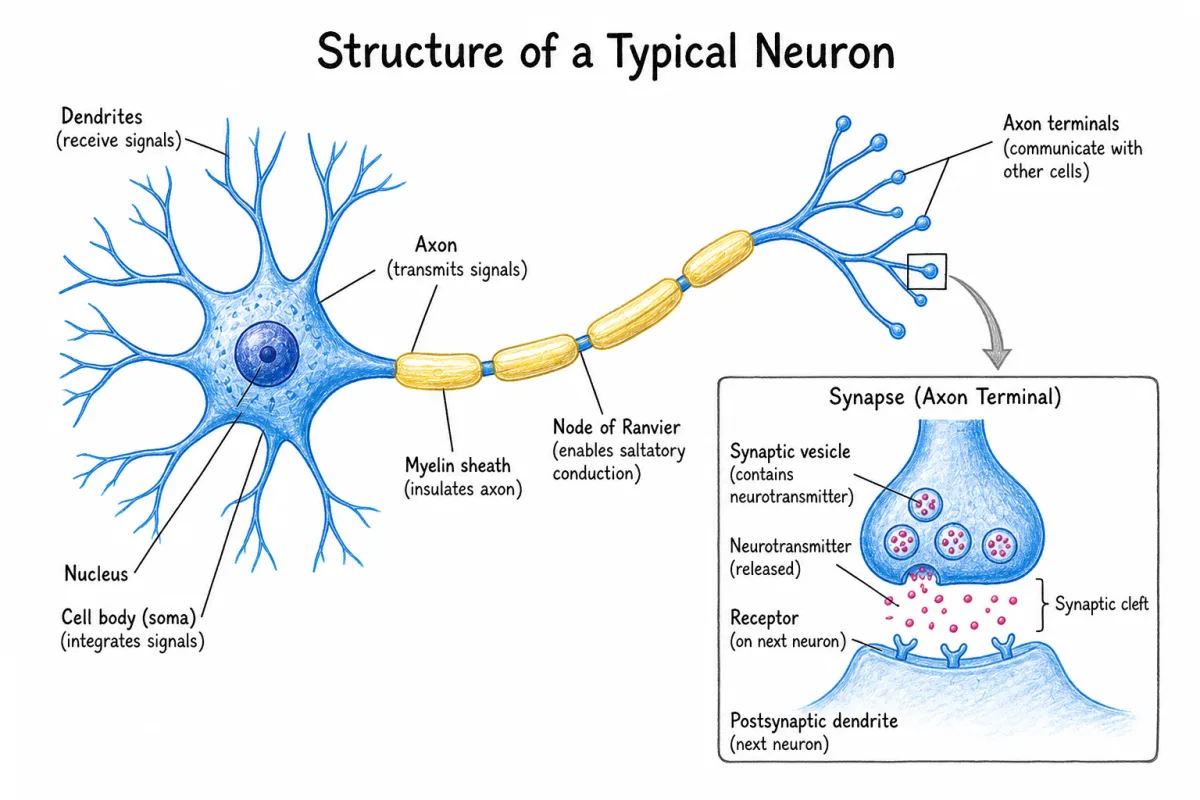
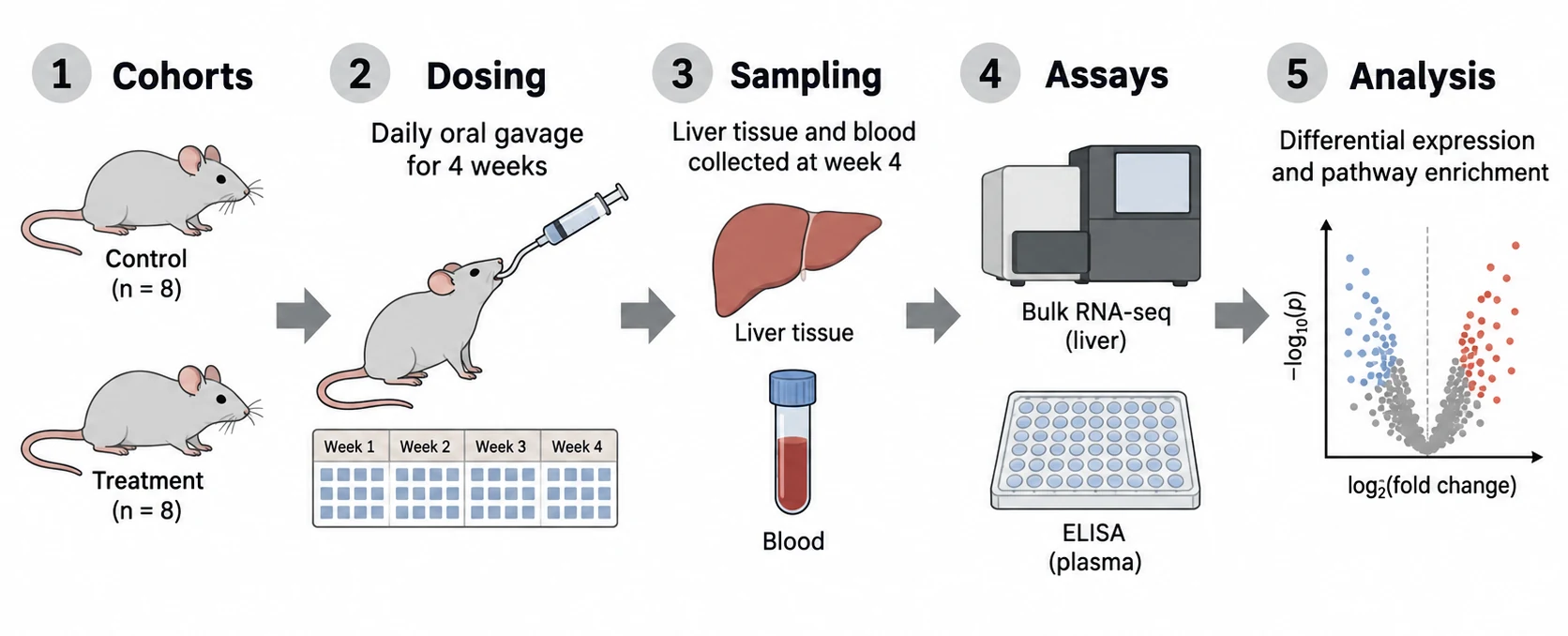
So the figure below is fine almost everywhere, with a disclosure. A micrograph "improved" by the same tool is fine nowhere.
Why journals treat images more strictly than text
It helps to understand why the rules are shaped this way, because then you can predict what a journal will say about a case its policy does not cover.
A paragraph written with AI help can be checked by reading it. A micrograph cannot be checked by looking at it. It is the evidence, and a reader has no way to tell a real one from a generated one. That is why every image-integrity policy, long before generative AI, already banned moving, deleting or inserting elements in a data image. Science puts it in one sentence: images presented in research papers should correctly represent the original data. Generative AI did not change the rule; it made breaking it effortless.
A diagram is different. It is not evidence of anything. It is a drawing of what you believe, and the reader judges it against their own knowledge and against your Methods. That is why publishers can afford to allow it, on the condition that a human stands behind every element. Elsevier’s policy says authors are responsible for ensuring the accuracy and originality of all images submitted for publication. Wiley says you must verify that AI-generated diagrams accurately represent established knowledge and contain no factual errors. Frontiers says figures produced by or edited using a generative AI technology must be checked to ensure they accurately reflect the data presented in the manuscript.
Read those three sentences together and the deal is clear. You may use the tool. You may not use it as an excuse.
What happens when nobody checks: the Frontiers retraction
In February 2024, Frontiers in Cell and Developmental Biology published a review on spermatogonial stem cells illustrated with AI-generated figures. It had been through peer review. Readers shared the figures within days, and the journal retracted the paper three days after publication. The retraction notice, which is still online, says: "Following publication, concerns were raised regarding the nature of its AI-generated figures. The article does not meet the standards of editorial and scientific rigor for Frontiers in Cell and Developmental Biology; therefore, the article has been retracted."
Two things about this case are worth noticing. It was a review, so the figures were illustrations, not data — the category most publishers permit. And Frontiers’ own policy permits AI-generated figures with an acknowledgment. The paper was retracted anyway, because the figures did not survive being looked at. Permission is necessary. It is not sufficient.
The practical lesson is not "avoid AI figures". It is that an AI figure has to pass the same test as one you drew by hand: could you defend every label, arrow and proportion to a reviewer in your field? If a label is gibberish, a structure is invented or a pathway runs the wrong way, the figure is wrong, and the tool that drew it is not a defence.
How to disclose an AI-assisted figure
Every publisher in the table wants a disclosure, and the ethics bodies behind them agree. COPE’s position statement says authors who use AI tools in the production of images or graphical elements of the paper must be transparent in disclosing, in the Materials and Methods or similar section, how the AI tool was used and which tool was used. ICMJE says journals should require authors to disclose whether they used AI-assisted technologies, and names image creators alongside chatbots. WAME asks for the tool, its version, and the prompts used to convert text into tables or illustrations.
Where exactly it goes differs by publisher, so here is the short version:
- Elsevier, Cell Press, Wiley — in the figure legend, plus the article’s general AI statement.
- IEEE — in the acknowledgments, naming the system and the sections it produced.
- JAMA — in the Acknowledgment section, with tool name, version and extension numbers, manufacturer, dates of use, what it did, and a statement that the authors take responsibility.
- PLOS, MDPI, Frontiers — in the Methods, with the tool named again in the acknowledgments at MDPI and Frontiers.
- BMJ — in the contributor section; in the Methods if AI was part of the research.
- Sage — in the Methods or acknowledgments, and declared at submission.
Elsevier supplies two model captions, and they are the ones to copy because they say the two things every editor is looking for: that AI made a draft and that a human finished it.
Figure 1. Schematic overview of study design. Initial image generated using [NAME OF TOOL/SERVICE] and subsequently edited by the authors. All elements were reviewed for accuracy and completeness.
Figure 2. Workflow diagram. Draft created with [NAME OF TOOL/SERVICE]. The final figure was refined and verified by the authors.
For figures made here, the credit line we suggest does the same job in one clause and adds something editors increasingly ask for, which is a way to check the provenance themselves:
Created with scientificfigure.com (License SF-2026-XXXXXX).
The number is a publication license certificate, issued from the Export menu in the editor on any paid plan. It records who generated the figure, when, a fingerprint of the original file, and the licence terms that apply. Anyone, including a reviewer, can enter the number at scientificfigure.com/verify or drop a copy of the figure there to match it against the record. Our publication license page explains what the certificate contains and what it does not claim.
Who owns an AI-generated figure?
Two questions hide inside this one, and journals care about them differently.
The first is copyright. The United States Copyright Office published its report on the copyrightability of AI outputs in January 2025. Its conclusion is that prompts alone, at this stage, are unlikely to give the person typing them copyright in the result. But it also says that in many circumstances these outputs will be copyrightable in whole or in part, where AI is used as a tool and where a human has been able to determine the expressive elements they contain. For a figure, that human contribution is the editing: choosing what stays, fixing what is wrong, arranging the panels, writing the labels. The more of that you do, the more of the figure is yours in the legal sense. This is one more reason the "draft, then edit" workflow is the right one.
The second question is the one editors actually ask: do you have the right to publish this image, and does it copy anyone else’s? Wiley’s guidance is the most direct. Authors must confirm that the AI technology does not claim ownership or copyright of their content or impose limitations on how it could be used, and it warns that AI-generated illustrations can incorporate visual elements from the AI’s training data. JAMA asks authors to indicate the rights or permissions to publish AI-generated content, as determined by the AI service or owner, in the Methods or in the figure legend. Elsevier notes that free versions of illustration tools are sometimes for educational or internal use only and may not permit publication.
So before you submit, read the terms of whatever tool you used and make sure they let you publish the output in a journal, in print and online, under the journal’s licence. Our Terms of Service assign to you all rights we hold in figures generated for you, for publications, presentations, teaching and commercial work, and the license certificate is the record of that grant. It is deliberately called a license, not a copyright registration, because the copyright status of AI output is the open question the Copyright Office describes. If a competing tool’s free tier does not say you may publish, treat that as a no. Our BioRender alternatives comparison notes which tools restrict publication on their free plans.
A workflow that survives peer review
Put together, the policies describe a single sensible process. Here it is as a checklist you can run for every figure.
-
Decide which category the figure is in before you open any tool. If it shows a measurement, an observation, a specimen or a patient, AI is out and so is AI cleanup. If it shows an idea, a process or a design, carry on.
-
Check the target journal’s policy page on the day you submit. Not the publisher’s blog post about it, the policy page. If the journal is a Science title, email the editor first. If it is a JAMA Network title and the figure is a clinical illustration, draw it another way.
-
Treat the render as a draft. Open it and check every label, every arrow direction, every count, every anatomical or chemical detail against what you know and what your Methods say. The figure above came back with a stray mark in an axis label; that is a normal outcome and the reason the step exists. In our editor every element is separable, so a fix is a click, not a regeneration. Our guide to how to make scientific figures covers what a finished figure has to satisfy on size, type and file format.
-
Export in the format the journal asks for. Vector for diagrams where the journal takes it; otherwise a raster at the stated resolution. Nothing about AI changes those rules.
-
Write the disclosure where the journal wants it, using the publisher’s own model wording. Name the tool. Say a human verified the result. If the journal wants a version number or a date, include them.
-
Keep a provenance record. Elsevier says authors may be asked to provide documentation of their AI use; Frontiers encourages uploading prompts as supplementary files. A license certificate, or at minimum the prompt and the date, answers that request in a minute instead of a week.
One more thing, since the question that started this article came from a reader who was about to submit. If a figure made here does go into a peer-reviewed paper, our Pioneer Program awards credits for published research that used the site, and asks only that you tell us the paper and, if you are willing, let us list its title. It is our way of finding out which figures actually made it through review, which is the feedback that improves the tool.
Frequently asked questions
Can AI-generated figures be used for SCI journal submission?
For explanatory figures — workflows, pathway diagrams, schematics, conceptual illustrations — yes at most major publishers, provided you check the figure, edit it yourself and disclose the tool in the legend. Elsevier, Cell Press, Wiley, Taylor & Francis, Frontiers, Sage, BMJ, IEEE and MDPI all say so in their current policies. For images that show data — microscopy, blots, gels, scans, patient photos — no publisher allows AI to create or alter them. Science and JAMA are the strict exceptions on illustrations: Science needs explicit editor permission for any AI-generated image, and JAMA does not accept AI-created clinical illustrations.
Do I have to say that a figure was made with AI?
Yes, everywhere we checked. COPE, ICMJE and WAME all ask for disclosure, and each publisher says where: Elsevier and Cell Press want it in the figure legend and in the article’s AI statement, IEEE in the acknowledgments, PLOS and MDPI in the Methods, JAMA in the Acknowledgment section with tool name, version, manufacturer and dates. Leaving it out is what gets papers rejected or corrected after publication, not the use itself.
Can I use AI to make a graphical abstract?
At Elsevier and Cell Press, not with a general-purpose image generator. Their policy says graphical abstracts should be made with dedicated scientific illustration tools that come with clear licensing terms, and the tool should be named in the caption. Other publishers we checked do not single out graphical abstracts; their general rules for illustrations apply.
Does Nature allow AI-generated figures?
Nature Portfolio’s AI policy, as it reads in September 2026, is a risk-based framework rather than a list of banned outputs. The only image-related item on its prohibited list is creating photorealistic images (deepfakes). Schematics and diagrams are not mentioned either way, so treat them as a case for the editor and disclose in full. Check the page itself before you submit — this is the policy that has changed most.
Can I use AI to clean up a microscopy image or a blot?
No. Elsevier and Cell Press say AI tools must not create or alter images that represent primary observed or experimental data, and that even brightness, contrast or colour-balance changes must be done in established image-processing software. Wiley says AI-edited photographs are not permitted. Taylor & Francis bans AI in the creation or manipulation of research or clinical outputs. This rule has no exceptions outside methods papers about AI itself.
Who owns the copyright of an AI-generated figure?
In the United States, the Copyright Office concluded in January 2025 that prompts alone are unlikely to give the user copyright in the output, but that outputs can be protected in whole or in part where a human determined the expressive elements. In practice, the more you edit and arrange the figure yourself, the stronger your position. Journals care less about copyright theory than about two practical things: that the tool’s terms let you publish the image, and that nothing in it copies someone else’s work.
Does a figure from Scientific Figure count as AI-generated?
Yes, and you should disclose it as such. Every figure here starts as an AI render, which you then check and edit. Paid plans can issue a numbered publication license certificate for each figure, and our suggested legend credit — "Created with scientificfigure.com (License SF-2026-XXXXXX)" — is a disclosure and a provenance record in one line. Editors can verify the number at scientificfigure.com/verify.
Where to go next
The policy question is settled quickly once the diagram-or-data question is. What takes longer is making the diagram good enough that a reviewer never thinks about how it was drawn.
- How to make scientific figures — column widths, type sizes, line weights and file formats, the parts of a figure no policy exempts.
- Graphical abstract requirements — the one figure Elsevier treats differently, and what each journal wants from it.
- BioRender alternatives — which illustration tools let you publish from a free plan and which do not, since that is now a question editors ask.
References
- Elsevier — Generative AI policies for journals — Elsevierhttps://www.elsevier.com/about/policies-and-standards/generative-ai-policies-for-journalsAccessed Sep 21, 2026
- Cell Press — Journal policies: Generative AI and figures, images, and artwork — Cell Press (Elsevier)https://www.cell.com/cell/information-for-authors/journal-policies#generativeAccessed Sep 21, 2026
- Nature Portfolio — Editorial policies: Artificial Intelligence (AI) — Springer Naturehttps://www.nature.com/nature-portfolio/editorial-policies/aiAccessed Sep 21, 2026
- Science Journals: Editorial Policies — AAAShttps://www.science.org/content/page/science-journals-editorial-policiesAccessed Sep 21, 2026
- Wiley — Best Practice Guidelines on Research Integrity and Publishing Ethics — Wileyhttps://authorservices.wiley.com/ethics-guidelines/index.htmlAccessed Sep 21, 2026
- Wiley — AI Guidelines for Researchers — Wileyhttps://www.wiley.com/en-us/publish/article/ai-guidelines/Accessed Sep 21, 2026
- IEEE Author Center — Submission and Peer Review Policies — IEEEhttps://journals.ieeeauthorcenter.ieee.org/become-an-ieee-journal-author/publishing-ethics/guidelines-and-policies/submission-and-peer-review-policies/Accessed Sep 21, 2026
- JAMA — Instructions for Authors — JAMA Networkhttps://jamanetwork.com/journals/jama/pages/instructions-for-authorsAccessed Sep 21, 2026
- Taylor & Francis — AI Policy — Taylor & Francishttps://taylorandfrancis.com/our-policies/ai-policy/Accessed Sep 21, 2026
- Frontiers — Policies and publication ethics — Frontiershttps://www.frontiersin.org/guidelines/policies-and-publication-ethicsAccessed Sep 21, 2026
- Retraction: Cellular functions of spermatogonial stem cells in relation to JAK/STAT signaling pathway — Frontiers in Cell and Developmental Biologyhttps://www.frontiersin.org/journals/cell-and-developmental-biology/articles/10.3389/fcell.2024.1386861/fullAccessed Sep 21, 2026
- BMJ — AI use policy — BMJhttps://authors.bmj.com/policies/ai-use/Accessed Sep 21, 2026
- Sage — Artificial intelligence policy — Sagehttps://us.sagepub.com/en-us/nam/artificial-intelligence-policyAccessed Sep 21, 2026
- MDPI — Research and Publication Ethics — MDPIhttps://www.mdpi.com/ethicsAccessed Sep 21, 2026
- PLOS ONE — Ethical Publishing Practice — PLOShttps://journals.plos.org/plosone/s/ethical-publishing-practiceAccessed Sep 21, 2026
- COPE position statement — Authorship and AI tools — Committee on Publication Ethicshttps://publicationethics.org/guidance/cope-position/authorship-and-ai-toolsAccessed Sep 21, 2026
- ICMJE Recommendations — Defining the Role of Authors and Contributors — International Committee of Medical Journal Editorshttps://www.icmje.org/recommendations/browse/roles-and-responsibilities/defining-the-role-of-authors-and-contributors.htmlAccessed Sep 21, 2026
- WAME Recommendations — Chatbots, Generative AI, and Scholarly Manuscripts — World Association of Medical Editorshttps://wame.org/page3.php?id=106Accessed Sep 21, 2026
- Copyright and Artificial Intelligence, Part 2: Copyrightability (January 2025) — United States Copyright Officehttps://www.copyright.gov/ai/Copyright-and-Artificial-Intelligence-Part-2-Copyrightability-Report.pdfAccessed Sep 21, 2026
Journal, conference and product names are the trademarks of their respective owners. This page is independent editorial content and is not affiliated with, authorised by, or endorsed by them. Specifications change — confirm every requirement against the official sources linked above before you submit or print.