
Food Web Maker
Describe an ecosystem and get a food web diagram — producers at the bottom, consumers stacked by trophic level, decomposers to one side, every arrow pointing from the organism eaten to the one that eats it. Or view the labeled and blank forest food web below, free.
Or start from an example
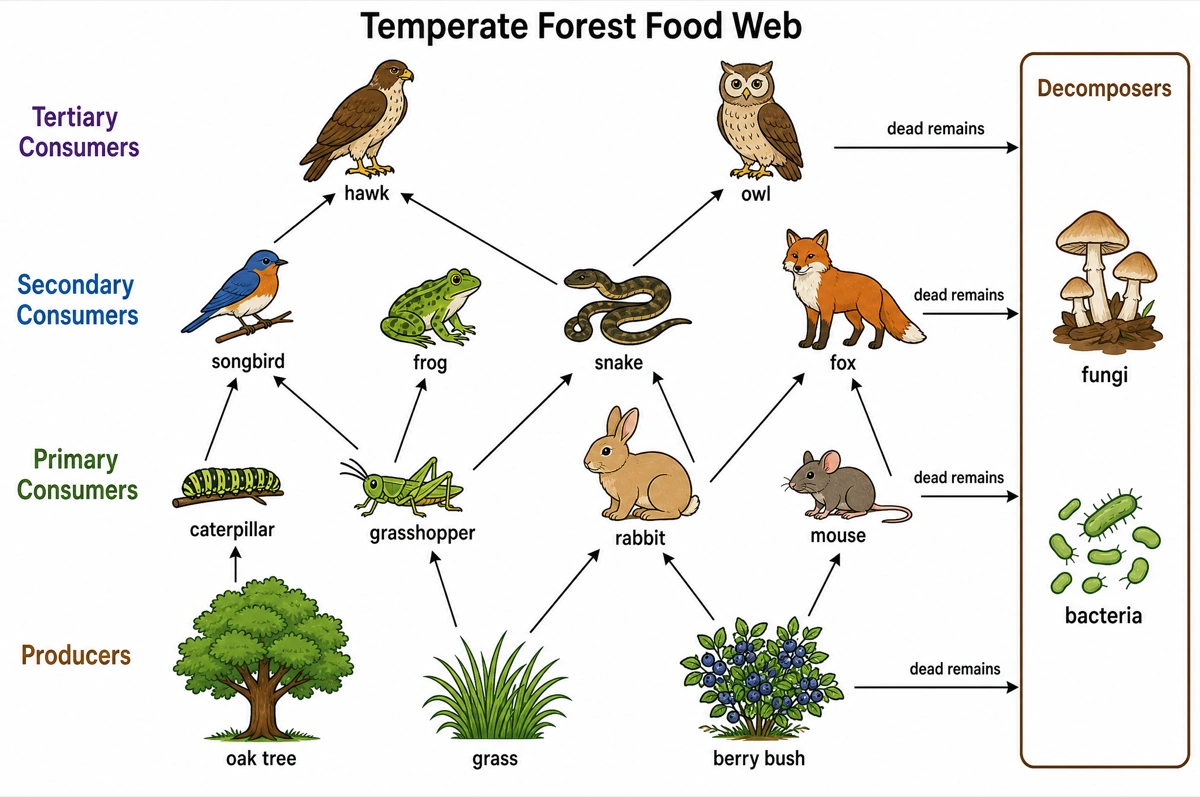
Labeled food web (answer key)
A temperate forest food web with producers, primary, secondary and tertiary consumers and decomposers, every arrow pointing from the organism eaten to the one that eats it. Use it as the answer key or as a food web template.
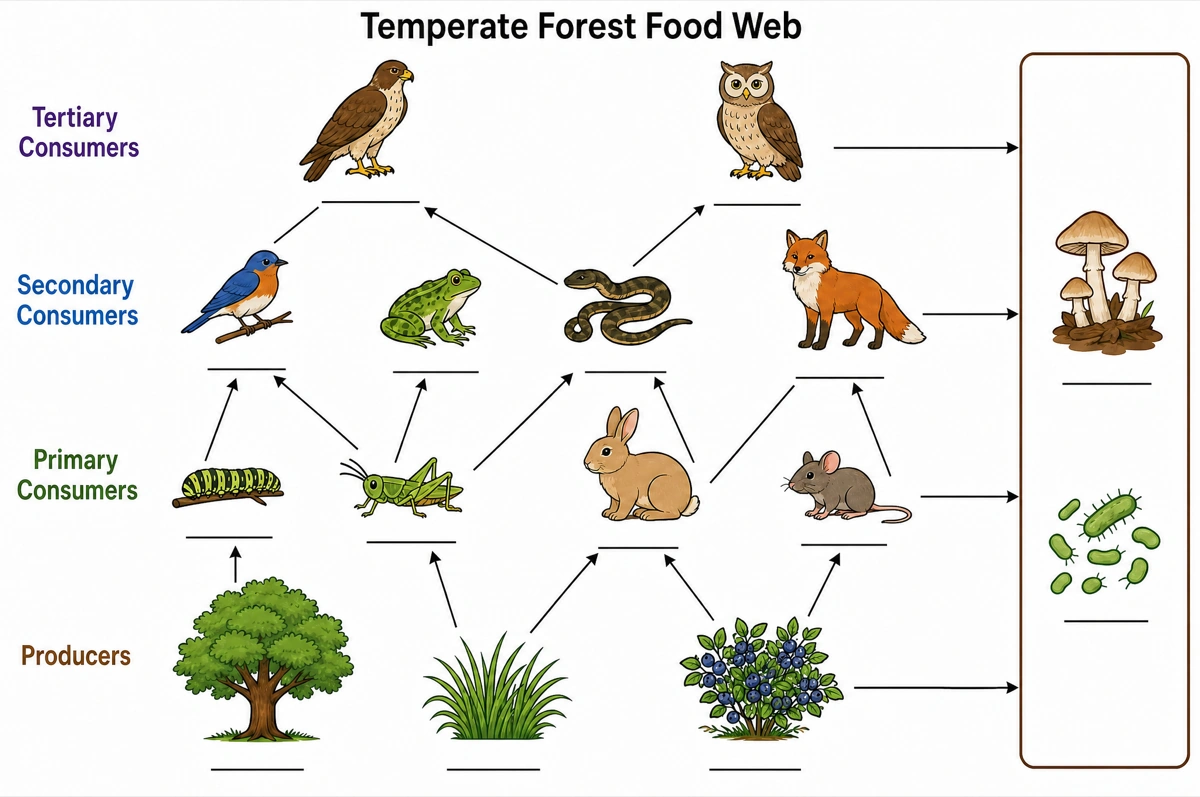
Blank food web to label
The same food web with an empty answer line in place of every organism name and the trophic levels kept down the side as a guide, ready for a worksheet: students name each organism, then trace the energy along the arrows.
What is a food web?
A food web is a diagram of the feeding relationships in one ecosystem: producers such as plants and algae at the base, the consumers that eat them stacked above by trophic level, and decomposers that break down the remains, all joined by arrows that point from the organism eaten to the organism that eats it — the direction energy flows. Where a food chain follows one path, a food web shows all of them at once.
Key facts
- Arrows follow the energy, not the hunt. Each arrow points from the organism that is eaten to the organism that eats it: grass → rabbit → fox. An arrow from the fox to the rabbit reverses the flow of energy, and it is the most common mistake on a food web worksheet.
- Every web rests on producers. Plants, algae and phytoplankton make their own food, mostly by photosynthesis, and form the first trophic level; herbivores are the primary consumers, and the carnivores that eat them are secondary and tertiary consumers.
- Energy shrinks at every step. In Howard T. Odum’s classic study of Silver Springs, Florida, producers made 20,819 kcal/m²/yr, primary consumers 3,368, secondary consumers 383 and tertiary consumers just 21 — which is why food chains rarely run past four or five levels.
- One animal can feed on several levels. Omnivores such as bears eat both berries and salmon, and a snake that eats mice and frogs is a secondary and a tertiary consumer at once.
- Decomposers recycle matter, not energy. Fungi and bacteria break down dead organisms and wastes from every level and return nutrients to the soil or water for producers to reuse; the energy itself leaves the web as heat.
How does the food web maker work?
Describe the ecosystem
Name the habitat and, if you like, the organisms — a temperate forest, a pond, a desert, the Antarctic Ocean. Say whether you want a full web, a five-organism overview or a blank worksheet.
Pick a style
The default is a clean flat textbook plate: a small drawing of each organism in rows by trophic level, arrows in the direction of energy flow. Or apply watercolor, ink line art and other finishes.
Refine and export
The result opens in your workspace, where you can redraw regions, edit labels on the canvas, upscale and export in high resolution.
Trophic levels in a food web
The roles a labeled food web is normally expected to show, what each one eats, examples from a temperate forest, and where each goes on the diagram. This is the default layout unless you ask for something else.
| Role | What it eats | Forest examples | Where to draw it |
|---|---|---|---|
| Producers (1st trophic level) | Nothing — makes its own food from sunlight, carbon dioxide and water by photosynthesis | Oak tree, grass, berry bush | Along the bottom row |
| Primary consumers (2nd level) | Producers — they are herbivores | Caterpillar, grasshopper, rabbit, mouse | In the row above the producers |
| Secondary consumers (3rd level) | Primary consumers | Songbird, frog, fox | In the row above the herbivores |
| Tertiary consumers (4th level) | Secondary consumers | Hawk eating snakes and songbirds | Near the top |
| Apex predators | Other consumers; nothing preys on them as adults | Hawk, great horned owl, wolf | At the very top |
| Omnivores | Both producers and consumers | Black bear, raccoon | Between rows, with arrows coming in from plants and from animals |
| Decomposers | Dead organisms and wastes from every level | Fungi, bacteria | To one side, with arrows coming in from every level |
| Detritivores | Dead plant and animal matter, eaten whole | Earthworms, millipedes, woodlice | Beside the decomposers |
Arrows always point toward the eater. Most worksheets also ask for the trophic level names down the side and for decomposers linked to every level. Name the organisms you need and only those are drawn.
Food chain vs food web: what is the difference?
A food chain is a single path of energy from a producer to a top consumer, such as grass → rabbit → fox; a food web joins every food chain in an ecosystem into one network, so each organism can have several foods and several predators. The web is the more realistic model; the chain is easier to read and to test on.
| Food chain | Food web | |
|---|---|---|
| Shape | One straight line | A network of crossing links |
| Paths for energy | One | Many, overlapping |
| Organisms per trophic level | Usually one | Several |
| Foods per animal | One | Often several; omnivores feed on more than one level |
| What it shows well | The order of trophic levels and the energy lost at each step | Competition, omnivory and how losing one species affects the others |
| If one species disappears | The chain simply breaks | Other links can make up for it, or the loss cascades through the web |
| Typical use | First introductions in primary school | Middle school onward, ecology courses and research |
Draw a food chain as one row of arrows and a food web as rows by trophic level, with the same arrow rule in both: from the organism eaten to the organism that eats it.
Where are food web diagrams used?
Food web diagrams are used mostly in science teaching — from elementary ecosystem units to university ecology — and as figures in ecology papers, conservation reports and environmental assessments. What changes is the size: five organisms for a first lesson, dozens of species with measured links in research.
School science
Ecosystem units from elementary through high school, including the NGSS models of matter and energy flow (5-LS2-1, MS-LS2-3). Usually a labeled web, plus the same drawing blank for students to complete.
University ecology
Lecture slides and exam questions on trophic levels, energy transfer efficiency, trophic cascades and biomagnification, where a pesticide such as DDT concentrates up the web.
Conservation and fieldwork
Figures for reports on a lake, a reef or a reserve, showing which species depend on one another before an invasive species arrives or a keystone predator is lost.
Posters and science fairs
A clear web of a local habitat — a pond, a school garden, a kelp forest — for a poster, a presentation or a science-fair board.
Common questions about food webs
How do I create a food web?
List the organisms in one ecosystem, sort them by what they eat — producers, primary, secondary and tertiary consumers, decomposers — and draw an arrow from each food to every animal that eats it. With this maker you describe the habitat or paste your list, and the web is drawn in rows by trophic level with every arrow pointing the right way.
Which way do the arrows go in a food web?
From the organism that is eaten to the organism that eats it — the direction energy flows. Grass → rabbit means the rabbit eats the grass. Arrows drawn from predator to prey are the error teachers see most often.
Can I get a blank food web for students to fill in?
Yes — view the blank version on this page free, or ask for one and every organism and trophic level name is replaced by an empty answer line. The labeled version is the matching answer key, so the two print as a pair.
Is there a free food web template?
Yes. The labeled and blank temperate forest food webs on this page are free to view, and you can generate a new template for any ecosystem. Ask for a pond, desert, ocean or grassland web and name the organisms your class studies.
What is the difference between a food chain and a food web?
A food chain follows one path of energy, such as grass → rabbit → fox; a food web joins all the food chains of an ecosystem, so one animal can eat several foods and be eaten by several predators. The comparison table above sets them side by side.
What are the trophic levels in a food web?
Producers form the first trophic level, herbivores (primary consumers) the second, carnivores that eat herbivores (secondary consumers) the third, and carnivores that eat other carnivores (tertiary consumers) the fourth, with apex predators at the top. Decomposers feed on dead matter from every level.
Where do decomposers go on a food web?
Usually to one side or along the bottom, with arrows running into them from every trophic level, since the remains of every level end up there. Some worksheets leave them out; ask for a web without decomposers and none are drawn.
Why do food webs rarely have more than four or five levels?
Because most of the energy at each level is used for living and lost as heat, so only a small fraction — often around 10% — passes to the next level. In Odum’s Silver Springs study, the tertiary consumers got about 0.1% of the energy the producers made.
What happens to a food web if one species is removed?
The effect spreads along its links. When sea otters decline, the sea urchins they eat multiply and strip the kelp forest bare — a trophic cascade. Ask for two webs side by side to show a food web before and after the loss.
Can I make a food chain instead?
Yes — ask for a food chain and the maker draws one row of organisms joined by arrows, from a producer to a top consumer, with the trophic level named under each.
How is this different from a generic AI image tool or a blank diagram editor?
The food web rules are built in. Every render is instructed to put producers at the bottom, stack consumers by trophic level, keep decomposers to one side and point every arrow from the eaten to the eater, with each name spelled exactly. Check the links against your course before printing; the canvas lets you move, relabel or redraw any part.
Can I use the food webs for school, teaching or publication?
Yes — diagrams you generate are yours to use in worksheets, presentations, handouts, posters and papers. Export high-resolution raster up to 4K depending on the model.
Sources
- Ecology of Ecosystems — Biology 2e, section 46.1 — OpenStax
- Energy Flow through Ecosystems — Biology 2e, section 46.2 — OpenStax
- Food Web — National Geographic Education
Keep exploring
Our other diagram tools, and the guides behind them.
Make your food web
From a list of organisms to a labeled, printable food web in about a minute.
Start drawing