
Orbital Diagram Generator
Make orbital diagrams for any element or ion, from nitrogen and oxygen to iron, chromium and Fe³⁺, with boxes in filling order, arrows set by Hund's rule and the electron configuration underneath. For chemistry classes.
Orbital diagram examples
Four orbital diagrams: oxygen with its two unpaired 2p electrons, iron with four unpaired 3d electrons, chromium's expected and actual filling one above the other, and a simple nitrogen diagram that shows Hund's rule. Every image came from the prompt printed with it, so picking one puts that exact prompt in the box above.
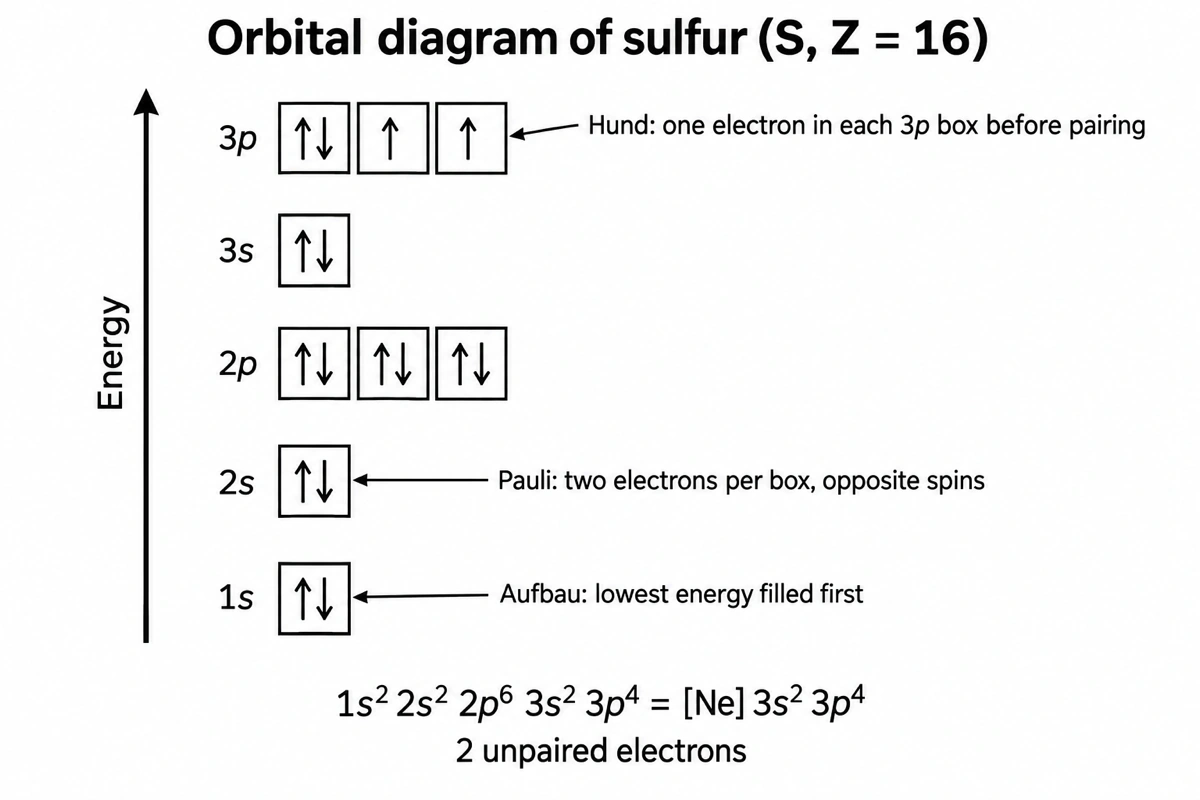
How to draw an orbital diagram: sulfur, step by step
The labeled figure is sulfur, 16 electrons, drawn with energy rising up the page. The same four moves give the orbital diagram of any atom.
- 1
Count the electrons
Sulfur's atomic number is 16, so 16 arrows; for an ion, add or subtract the charge.
- 2
Fill boxes in Aufbau order
1s, 2s, 2p, 3s, 3p from the bottom up, two opposite arrows per box (Pauli).
- 3
Spread the 3p electrons first
One arrow in each 3p box, then the fourth pairs in the first box (Hund's rule).
- 4
Write the configuration
1s² 2s² 2p⁶ 3s² 3p⁴, or [Ne] 3s² 3p⁴, with 2 unpaired electrons.
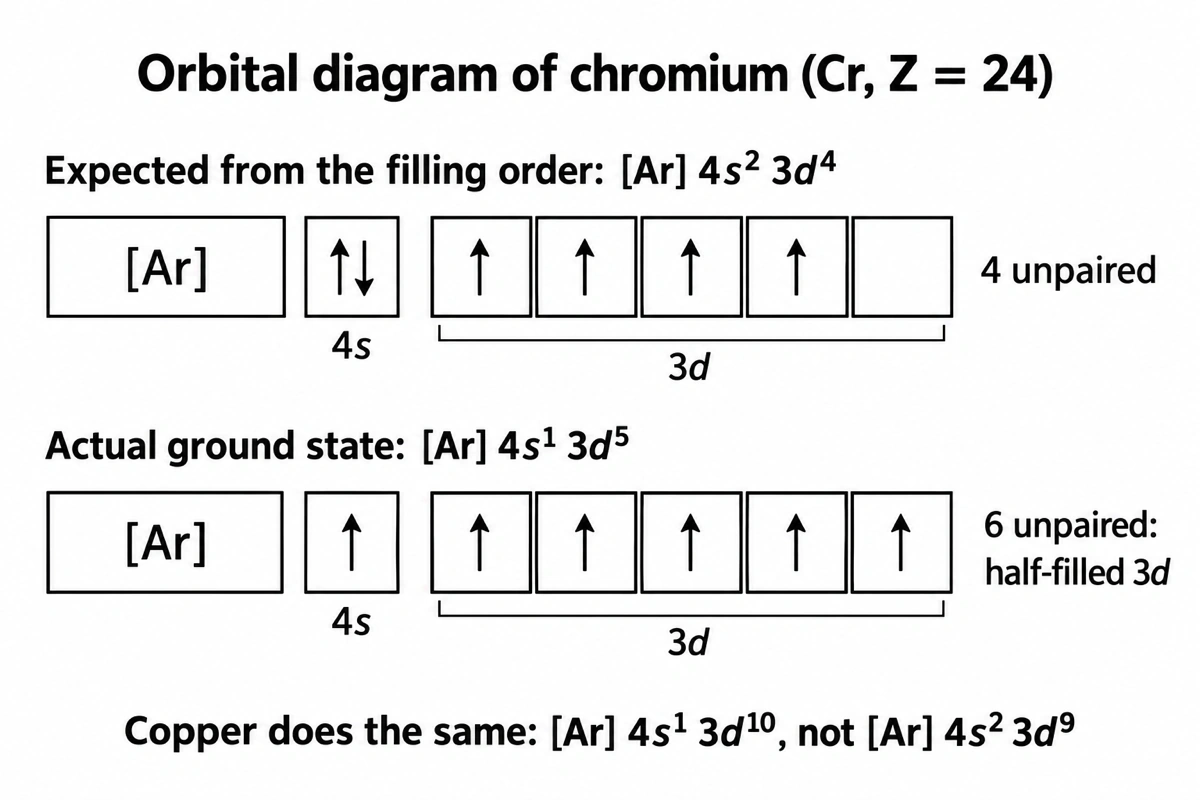
Why chromium's orbital diagram breaks the filling order
The filling order predicts [Ar] 4s² 3d⁴ for chromium. The measured ground state moves one electron up and leaves both subshells half full.
- 1
Expected: 4 unpaired
4s holds a pair and four of the five 3d boxes hold one arrow; the fifth stays empty.
- 2
Actual: 6 unpaired
One 4s electron joins 3d: [Ar] 4s¹ 3d⁵, all six arrows single and parallel.
- 3
Copper follows suit
[Ar] 4s¹ 3d¹⁰ instead of 4s² 3d⁹: a full 3d set wins over a full 4s box.
Orbital diagrams element by element, with the Aufbau chart
The per-element diagrams searched for most, grouped where the arrow pattern repeats. Each entry gives the electron count, the boxes, where the arrows go and how many stay unpaired.
Orbital diagram for hydrogen, helium, lithium and beryllium
The smallest diagrams, and the place to show the Pauli principle. Hydrogen (1): 1s¹, one up-arrow in one box. Helium (2): 1s², one up and one down arrow in the same box. Lithium (3): 1s² 2s¹, the first atom with a second shell, 1 unpaired. Beryllium (4): 1s² 2s², every arrow paired.
Orbital diagram for nitrogen
7 electrons: 1s² 2s² 2p³. Pairs in 1s and 2s, then one up-arrow in each of the three 2p boxes and no pairing, because Hund's rule fills every box of a set singly first. 3 unpaired electrons: the half-filled 2p set is why nitrogen's first ionization energy is higher than oxygen's.
Orbital diagram for oxygen
8 electrons: 1s² 2s² 2p⁴. The fourth 2p electron has to pair, so the first 2p box holds ↑↓ and the other two hold one arrow each: 2 unpaired electrons. The repulsion inside that one paired box is why oxygen gives up an electron more easily than nitrogen does.
Orbital diagram for carbon
6 electrons: 1s² 2s² 2p². The two 2p electrons sit in separate boxes with parallel spins, 2 unpaired, never paired in one box. A diagram that lifts one 2s electron into 2p to give four single arrows is carbon's excited state, drawn to explain sp³ hybridization, not its ground-state orbital diagram.
Orbital diagram for boron, aluminum and silicon
Boron (5): 1s² 2s² 2p¹, one arrow in the first 2p box and two empty 2p boxes. Aluminum (13): [Ne] 3s² 3p¹, the same pattern one row down. Silicon (14): [Ne] 3s² 3p², two single 3p arrows, like carbon. Draw the empty p boxes too: a p set is three boxes whether or not they are filled.
Orbital diagram for sulfur and phosphorus
One row below oxygen and nitrogen, with the same outer pattern after a full neon core. Phosphorus (15): [Ne] 3s² 3p³, three single 3p arrows, 3 unpaired. Sulfur (16): [Ne] 3s² 3p⁴, one 3p pair and two single arrows, 2 unpaired. The full diagram shows the ten core electrons in 1s, 2s and 2p below them.
Orbital diagram for chlorine, fluorine and bromine
Halogens end one electron short of a full p set, ns² np⁵. Fluorine (9): 1s² 2s² 2p⁵. Chlorine (17): [Ne] 3s² 3p⁵. Bromine (35): [Ar] 4s² 3d¹⁰ 4p⁵, with a full 3d set drawn between 4s and 4p. In each, two p boxes hold pairs and the third one arrow: 1 unpaired electron.
Orbital diagram for sodium, magnesium, potassium and calcium
Sodium (11): [Ne] 3s¹, one arrow in 3s. Magnesium (12): [Ne] 3s², paired, no unpaired electrons. Potassium (19): [Ar] 4s¹ and calcium (20): [Ar] 4s². Neither has any 3d boxes: 4s lies below 3d until scandium, so the 19th electron goes into 4s, not 3d.
Orbital diagram for iron
26 electrons: [Ar] 4s² 3d⁶. 4s is paired; in the five 3d boxes the first five electrons go in one each and the sixth pairs in the first box: 4 unpaired electrons, so iron atoms are paramagnetic. Fe²⁺ is [Ar] 3d⁶, the two 4s electrons gone first and still 4 unpaired; Fe³⁺ is [Ar] 3d⁵, one arrow in every 3d box, 5 unpaired.
Orbital diagram for chromium and copper
The two first-row exceptions. Chromium (24): [Ar] 4s¹ 3d⁵, not 4s² 3d⁴, six single arrows. Copper (29): [Ar] 4s¹ 3d¹⁰, not 4s² 3d⁹, a full 3d set and 1 unpaired electron. Name the exception and it is drawn as measured; ask for expected and actual together and you get the two rows of the chromium example above.
Orbital diagram for titanium, manganese, cobalt, nickel and zinc
After 4s fills, the 3d boxes take one arrow each before any pairs. Titanium (22): [Ar] 4s² 3d², 2 unpaired. Manganese (25): [Ar] 4s² 3d⁵, 5 unpaired. Cobalt (27): [Ar] 4s² 3d⁷, 3 unpaired. Nickel (28): [Ar] 4s² 3d⁸, 2 unpaired. Zinc (30): [Ar] 4s² 3d¹⁰, none, so zinc is diamagnetic.
Orbital diagram for neon and argon
Noble gases fill every box they have. Neon (10): 1s² 2s² 2p⁶, five boxes and ten paired arrows. Argon (18): 1s² 2s² 2p⁶ 3s² 3p⁶, nine boxes, all paired. With nothing unpaired both are diamagnetic, and their configurations become the [Ne] and [Ar] cores that start the condensed diagrams of the elements after them.
Aufbau diagram (filling order chart)
Not one atom but the order every atom fills in: the subshells written in rows by shell (1s; 2s 2p; 3s 3p 3d; 4s 4p 4d 4f …) and crossed by diagonal arrows, which read off 1s, 2s, 2p, 3s, 3p, 4s, 3d, 4p, 5s, 4d, 5p, 6s, 4f, 5d, 6p, 7s. It encodes the n + l (Madelung) rule: lower n + l fills first and a tie goes to the lower n, so 4s (4 + 0) comes before 3d (3 + 2).
Orbital energy diagram
The same boxes stacked up an energy axis instead of laid out in a row, as in the sulfur figure above: each subshell at its own height, the three p or five d boxes side by side at one level because they are degenerate. It is the version that shows why 4s sits below 3d in potassium, and how far apart the last filled and first empty subshells are.
Orbital filling and unpaired electrons, hydrogen to bromine
Ground-state configurations as general chemistry textbooks give them, with the arrows in the last subshell to fill (□ is an empty box). The unpaired count is the number of single arrows in the whole diagram.
| Element | Electrons | Condensed configuration | Last subshell's boxes | Unpaired electrons |
|---|---|---|---|---|
| H | 1 | 1s¹ | 1s: ↑ | 1 |
| He | 2 | 1s² | 1s: ↑↓ | 0 |
| Li | 3 | [He] 2s¹ | 2s: ↑ | 1 |
| B | 5 | [He] 2s² 2p¹ | 2p: ↑ □ □ | 1 |
| C | 6 | [He] 2s² 2p² | 2p: ↑ ↑ □ | 2 |
| N | 7 | [He] 2s² 2p³ | 2p: ↑ ↑ ↑ | 3 |
| O | 8 | [He] 2s² 2p⁴ | 2p: ↑↓ ↑ ↑ | 2 |
| F | 9 | [He] 2s² 2p⁵ | 2p: ↑↓ ↑↓ ↑ | 1 |
| Ne | 10 | [He] 2s² 2p⁶ | 2p: ↑↓ ↑↓ ↑↓ | 0 |
| Na | 11 | [Ne] 3s¹ | 3s: ↑ | 1 |
| Mg | 12 | [Ne] 3s² | 3s: ↑↓ | 0 |
| Al | 13 | [Ne] 3s² 3p¹ | 3p: ↑ □ □ | 1 |
| Si | 14 | [Ne] 3s² 3p² | 3p: ↑ ↑ □ | 2 |
| P | 15 | [Ne] 3s² 3p³ | 3p: ↑ ↑ ↑ | 3 |
| S | 16 | [Ne] 3s² 3p⁴ | 3p: ↑↓ ↑ ↑ | 2 |
| Cl | 17 | [Ne] 3s² 3p⁵ | 3p: ↑↓ ↑↓ ↑ | 1 |
| Ar | 18 | [Ne] 3s² 3p⁶ | 3p: ↑↓ ↑↓ ↑↓ | 0 |
| K | 19 | [Ar] 4s¹ | 4s: ↑ | 1 |
| Ca | 20 | [Ar] 4s² | 4s: ↑↓ | 0 |
| Ti | 22 | [Ar] 4s² 3d² | 3d: ↑ ↑ □ □ □ | 2 |
| Cr | 24 | [Ar] 4s¹ 3d⁵ (exception) | 4s: ↑, 3d: ↑ ↑ ↑ ↑ ↑ | 6 |
| Mn | 25 | [Ar] 4s² 3d⁵ | 3d: ↑ ↑ ↑ ↑ ↑ | 5 |
| Fe | 26 | [Ar] 4s² 3d⁶ | 3d: ↑↓ ↑ ↑ ↑ ↑ | 4 |
| Co | 27 | [Ar] 4s² 3d⁷ | 3d: ↑↓ ↑↓ ↑ ↑ ↑ | 3 |
| Ni | 28 | [Ar] 4s² 3d⁸ | 3d: ↑↓ ↑↓ ↑↓ ↑ ↑ | 2 |
| Cu | 29 | [Ar] 4s¹ 3d¹⁰ (exception) | 4s: ↑, 3d: five pairs | 1 |
| Zn | 30 | [Ar] 4s² 3d¹⁰ | 3d: five pairs | 0 |
| Br | 35 | [Ar] 4s² 3d¹⁰ 4p⁵ | 4p: ↑↓ ↑↓ ↑ | 1 |
Scandium to zinc fill 3d after 4s, and only chromium and copper step out of line. Scandium ([Ar] 4s² 3d¹, 1 unpaired) and vanadium ([Ar] 4s² 3d³, 3 unpaired) follow the pattern. For a cation, take electrons from the highest n first: Cu⁺ and Zn²⁺ are both [Ar] 3d¹⁰.
Orbital diagram vs electron configuration vs Bohr model
All three describe the same electrons. The electron configuration writes them as a line of text (1s² 2s² 2p⁴), the orbital diagram draws each orbital with its arrows, and the Bohr model draws only shells as rings, with no subshells and no spin. Orbital notation is the box-and-arrow form, and most courses use it as another name for the orbital diagram.
| Orbital diagram | Electron configuration | Bohr model | |
|---|---|---|---|
| What it shows | Every orbital as a box, each electron as an arrow | Subshells with superscript electron counts | Shells as rings, electrons as dots |
| Oxygen | 1s ↑↓, 2s ↑↓, 2p ↑↓ ↑ ↑ | 1s² 2s² 2p⁴, or [He] 2s² 2p⁴ | 2 dots on the first ring, 6 on the second |
| Spin | Shown by up and down arrows | Not shown | Not shown |
| Unpaired electrons | Count the single arrows | Worked out with Hund's rule | Cannot be read |
| Subshells (s, p, d) | Sets of 1, 3 and 5 boxes | Written as 1s, 2p, 3d … | None, shells only |
| Against a molecular orbital diagram | One atom; an MO diagram puts two atoms' orbitals in its outer columns and combines them | Molecules get MO configurations instead, written σ2s² σ*2s² … | No molecular counterpart |
Draw the orbital diagram when the question is about spin or magnetism. "How many unpaired electrons does iron have?" needs the five 3d boxes drawn out; "what is the electron configuration of iron?" needs only [Ar] 4s² 3d⁶.
What is an orbital diagram?
An orbital diagram (also called an orbital box diagram or orbital filling diagram) shows where an atom's electrons are: one box or line per orbital, grouped into subshells (1s, 2s, 2p, 3s …) in filling order, with each electron drawn as a half-arrow whose direction stands for its spin. It carries the same count as the electron configuration, 1s² 2s² 2p⁴ for oxygen, plus what the configuration leaves out: which orbitals hold a pair and which hold a single, unpaired electron.
Key facts
- Three rules place every arrow. Aufbau: fill the lowest-energy subshell first. Pauli: at most two electrons per orbital, with opposite spins. Hund: in a set of equal-energy orbitals, one electron goes into each before any pairs, all with the same spin.
- 4s fills before 3d, and empties before it too. Potassium and calcium put their outer electrons in 4s and scandium starts 3d. When a transition metal forms a cation it loses its 4s electrons first: Fe is [Ar] 4s² 3d⁶, Fe²⁺ is [Ar] 3d⁶.
- s, p, d and f sets have 1, 3, 5 and 7 orbitals. So an s subshell holds 2 electrons, p 6, d 10 and f 14, which is why the blocks of the periodic table are 2, 6, 10 and 14 elements wide.
- Unpaired electrons make an atom paramagnetic. Count the single arrows: nitrogen has 3, oxygen 2, iron 4, chromium 6. An atom with every arrow paired, such as neon or zinc, is diamagnetic.
- Chromium and copper break the simple order. Cr is [Ar] 4s¹ 3d⁵ and Cu is [Ar] 4s¹ 3d¹⁰: a half-filled or full 3d set is lower in energy than the configuration the filling order predicts. Molybdenum and silver, directly below them, do the same with 5s and 4d.
Questions about orbital diagrams
How do you draw an orbital diagram?
Count the electrons, draw the subshells in filling order (1s, 2s, 2p, 3s, 3p, 4s, 3d …) as one box per orbital, and fill the boxes from the lowest up: two arrows per box pointing opposite ways, and one arrow in every box of a p or d set before any of them pairs. Stop when the arrows equal the atomic number, write the configuration underneath, and count the single arrows to get the unpaired electrons.
What is orbital notation?
Orbital notation is the electron configuration drawn as boxes or lines, one per orbital and labeled with its subshell, with each electron as an up or down arrow. Oxygen in orbital notation is 1s ↑↓, 2s ↑↓, 2p ↑↓ ↑ ↑. Textbooks that use the term keep "electron configuration" or "spdf notation" for the written form, 1s² 2s² 2p⁴.
What is the difference between an orbital diagram and an electron configuration?
The electron configuration says how many electrons each subshell holds; the orbital diagram also shows how they sit inside it. Both give 2p⁴ for oxygen, but only the diagram shows one 2p orbital paired and two holding single electrons, which is where oxygen's 2 unpaired electrons come from.
What is an Aufbau diagram?
An Aufbau diagram is the chart of the order in which subshells fill: the subshells written in rows by shell and crossed by diagonal arrows, read 1s, 2s, 2p, 3s, 3p, 4s, 3d, 4p, 5s and on. It follows the n + l rule. It is the tool for building an orbital diagram, not a diagram of any one atom.
Why does 4s fill before 3d?
Because for potassium and calcium 4s sits below 3d in energy: its n + l is 4, against 5 for 3d. Once 3d begins to fill, from scandium on, the 3d orbitals drop below 4s, which is why transition-metal cations lose their 4s electrons first: Fe²⁺ is [Ar] 3d⁶, not [Ar] 4s² 3d⁴.
Why are chromium and copper exceptions?
A half-filled or completely filled 3d set is more stable than the configuration the filling order predicts, so one 4s electron moves into 3d. Chromium is [Ar] 4s¹ 3d⁵ instead of 4s² 3d⁴, and copper is [Ar] 4s¹ 3d¹⁰ instead of 4s² 3d⁹. The 4s and 3d energies are so close there that the extra stability of the parallel 3d spins tips the balance.
How many unpaired electrons does iron have?
Four. Iron is [Ar] 4s² 3d⁶: 4s is paired, and of the six 3d electrons the first five go into separate boxes and the sixth pairs with one of them, leaving four single arrows. Fe³⁺, [Ar] 3d⁵, has five, one in every 3d box.
How do you draw an orbital diagram for an ion?
Start from the neutral atom's diagram and add or remove arrows for the charge. Anions take the extra electrons in the next open box: Cl⁻ is [Ne] 3s² 3p⁶. Cations lose them from the highest n first, so transition metals lose 4s before 3d: Fe³⁺ is [Ar] 3d⁵, five single arrows and no 4s box.
What does a valence electron orbital diagram show?
Only the outer shell: the s and p boxes of the highest n, with the core written as a noble-gas symbol. Sulfur's is [Ne] followed by 3s ↑↓ and 3p ↑↓ ↑ ↑, its 6 valence electrons and 2 unpaired ones. For transition metals the 3d boxes are usually drawn as well, since those electrons take part in bonding.
Why do the two arrows in one box point opposite ways?
The Pauli exclusion principle: two electrons in the same orbital must have opposite spins, +½ and −½, drawn as one up-arrow and one down-arrow. No orbital can take a third electron, so a box never holds more than two arrows.
Sources
- 5.17: Hund's Rule and Orbital Filling Diagrams, Introductory Chemistry (CK-12) — LibreTexts
- Orbital Diagrams, General Chemistry — Chemistry Steps
Keep exploring
Our other diagram tools, and the guides behind them.

Draw your orbital diagram
Name an element or ion and get its boxes, arrows and configuration, ready for an answer key or a slide.
Start drawing