The legend is the only part of a figure a reader is guaranteed to read, and it is the part most often written last, in a hurry, from the caption of an earlier paper. This is what nine publishers actually require it to contain, what they cap its length at, and one worked legend taken apart clause by clause.

A reader meets your figure before they meet your paper. They arrive from a search result, a slide, a journal club, or their own scroll through the PDF, and the first thing they read is not your Results section — it is the block of text under the artwork. If that block does not tell them what they are looking at, the figure has failed, no matter how well it was drawn.
Nearly every publisher says so in the same words. Figures should be self-explanatory. Almost none of them say what that means in practice, which is why legends get written last, in the final hour, by copying the shape of a caption from an earlier paper and hoping.
The requirements do exist. They are scattered across nine documents, they disagree in places, and one of them uses the word "legend" to mean something entirely different from the rest. This page collects them.
What a figure legend is
A figure legend is the text that makes a figure readable without the paper around it. The ICMJE Recommendations state the principle as a rule about placement: "Titles and detailed explanations belong in the legends—not on the illustrations themselves." The same document adds the operational half: "When symbols, arrows, numbers, or letters are used to identify parts of the illustrations, identify and explain each one clearly in the legend."
That is the whole job, and it decomposes into four things:
- A title sentence stating what the figure shows.
- A pass through the panels, in the order they are lettered.
- A definition of every mark — symbols, arrows, colours, scale bars.
- The numbers behind the data — n, error bars, the statistical test.
Everything else in a legend is either methods that belong in Methods, or restatement of the axis labels.
Figure legend, figure caption, or the key inside the plot?
Three different things travel under overlapping names, and searching for any of them returns the other two.
The legend as text under the figure. This is the life-science usage and the subject of this page. Journals treat "legend" and "caption" as synonyms: JAMA runs both words in one heading, "Figure Titles and Legends (Captions)", and Science calls the same block a caption throughout while Nature calls it a legend throughout. Nothing turns on which word you use.
The legend as the key inside a plot. In MATLAB, matplotlib, ggplot2 and
Excel, legend() draws the small box mapping colours and symbols to series
names. It sits inside the axes. It is not the text under the figure, and a
journal asking for a legend is not asking you to add one of these — in fact
Nature asks for the opposite, that "where possible, text, including keys to
symbols, should be provided in the legend rather than on the figure itself."
The legend in APA Style. APA uses the word for the key, not the text. That distinction is worth its own section further down, because a psychology manuscript formatted on life-science instincts gets both objects wrong.
What journals require the legend to contain
Nine documents, read the same day, reduce to this. "Not stated" is a real finding and appears where the publisher genuinely does not address the point on its author-facing pages — filling those gaps with a plausible number is how most advice on this topic goes wrong.
| Publisher | The legend must open with | The legend must define | Where the legend sits |
|---|---|---|---|
| Nature | A brief title for the whole figure | A short description of each panel and the symbols used; all error bars and statistics; unusual units and abbreviations | Alongside its figure at initial submission; listed one after another after the reference list in the final paper |
| Science | The label “Fig. 1” as a new paragraph, then the figure’s title | Details behind any key; keys themselves kept as simple as possible | In the manuscript file; the title must not be in the figure itself |
| Cell Press | Not stated | Image processing steps, gel splices, single-channel alterations, reused images and the reason for reuse; scale bar size on micrographs | At the end of the main manuscript file, never inside the image file |
| PNAS | For multi-panel figures, a brief overview of the entire figure | Each panel, referenced and described at least once; error bars; the number of independent data points (N) | Immediately after the paragraph referencing the figure |
| eLife | Not stated | Statistical tests applied, exact sample number, p values, criteria for data inclusion or exclusion, details of replicates; sample size and error bar definition wherever error bars appear | With the figure; complete enough that no explainer video is needed |
| PLOS ONE | A figure label and a figure title of 15 words or less | Nothing specified beyond the title; the legend itself is optional, and figure credits go in its last sentence | In the manuscript text, immediately after the paragraph first citing the figure |
| JAMA | A figure title, which is required; the legend itself is optional | All labels, arrows and markers; all symbols, indicators, line styles and colours, in a key or the legend; any digital enhancement; SI conversion factors | At the end of the manuscript |
| ICMJE | A title, which belongs in the legend rather than on the illustration | Every symbol, arrow, number or letter used to identify parts of the illustration; on photomicrographs, the internal scale and the staining method | Not stated |
Two rows deserve reading twice.
eLife asks for more than anyone else, and asks for it in the legend specifically. Its author guide requires that authors "provide information about data processing and analysis in their figure legends, including any statistical tests applied, with exact sample number, p values of tests, criteria for data inclusion or exclusion, and details of replicates." Where error bars appear it adds that "the figure/figure legend should clearly indicate the sample size (n), define the error bars, and provide all statistical information including the statistical method used and levels of significance." A legend written to eLife's standard satisfies every other journal on this table.
Cell Press is the one whose requirements are about honesty rather than clarity. Splicing lanes out of a gel, altering a single colour channel, or using the same image in two figures are all permitted and all must be declared in the legend. That makes the legend the place a reader learns what was done to the image, which is a different function from the other eight rows.
Length limits, and whether the legend counts against yours
Two questions authors ask that most guides do not answer, because the answers sit in different parts of each journal's instructions.
| Journal | Stated limit on the legend | Counts toward the article word limit? |
|---|---|---|
| Nature | Fewer than 300 words each | Legends are listed separately, after the reference list, in the final paper |
| PNAS | No number; legends “should only include brief descriptions of the figures” | Yes for Brief Reports — the roughly 1,600-word allowance covers text, title page, abstract and figure legends together |
| eLife | None stated | No — legends are excluded from the suggested 5,000 words for Research Articles and the 1,500 for Short Reports |
| JAMA | None stated; the legend is optional, the title is not | No — the manuscript word count excludes tables and figure legends |
| PLOS ONE | Title 15 words or less; no limit stated for the legend body | Not stated |
| Science | None stated beyond “brief legends” | Not stated |
| Cell Press | None stated | Not stated |
Nature's 300 words is the only hard cap any of these publishers puts in writing, and it is generous. A legend that runs past it has usually absorbed methods, which Nature forbids separately: "If the paper contains a Methods section, legends should not contain any details of methods."
The PNAS row is the one that catches people. A Brief Report budget of about 1,600 words that includes the legends means four dense legends can cost you a paragraph of Discussion, so the trimming has to happen deliberately rather than at proof stage.
A figure legend example, clause by clause
Requirements read as a list are hard to apply. Here is one legend written to satisfy every row in the table above, on a figure built for this article.
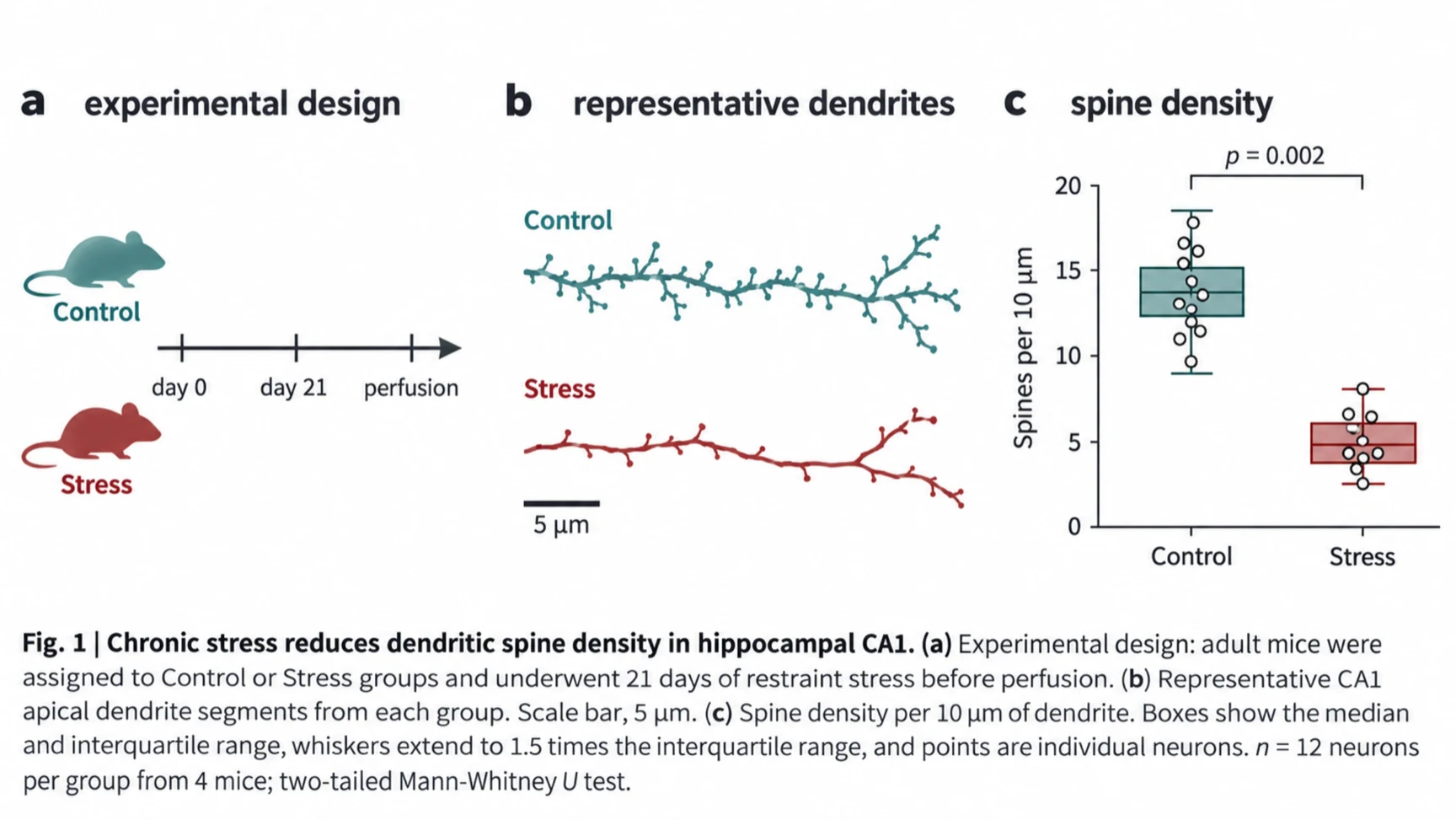
The legend reads:
Fig. 1 | Chronic stress reduces dendritic spine density in hippocampal CA1. (a) Experimental design: adult mice were assigned to Control or Stress groups and underwent 21 days of restraint stress before perfusion. (b) Representative CA1 apical dendrite segments from each group. Scale bar, 5 μm. (c) Spine density per 10 μm of dendrite. Boxes show the median and interquartile range, whiskers extend to 1.5 times the interquartile range, and points are individual neurons. n = 12 neurons per group from 4 mice; two-tailed Mann-Whitney U test.
Ninety-one words. Taken apart:
"Fig. 1 |" — the label Science asks you to begin the caption with, as its own paragraph. The vertical rule after it is Nature house style separating the title from the body; other journals use a full stop.
"Chronic stress reduces dendritic spine density in hippocampal CA1." — the title sentence Nature and PNAS both require. It states the finding rather than the topic. "Effect of chronic stress on dendritic spines" would name the subject and tell the reader nothing; this version means a person who reads only the legend leaves with the result. Eleven words, inside the 15 PLOS ONE allows for a title.
"(a) … (b) … (c) …" — PNAS asks that each panel be referenced and described at least once, and that a multi-panel figure open with an overview of the whole. Both are satisfied: the title sentence covers the figure, then each letter gets its clause, in the order the panels are lettered.
"Scale bar, 5 μm." — ICMJE requires photomicrographs to carry internal scale markers and requires the legend to explain them; Cell Press requires a scale bar on all microscopy images and requires the legend to reference its size. A scale bar drawn but never given a value fails both. This is the single most common omission in figures that are otherwise carefully made.
"Boxes show the median and interquartile range, whiskers extend to 1.5 times the interquartile range, and points are individual neurons." — Nature's requirement that all error bars and statistics be defined in the legend. It matters more than it looks: box plot conventions are not standardised, and the same values produce a figure with an outlier under one convention and none under another, which our box plot examples page works through with the arithmetic.
"n = 12 neurons per group from 4 mice" — PNAS's number of independent data points and eLife's exact sample number, with the nesting made explicit. "n = 12" alone invites a reviewer to ask twelve of what, from how many animals. Answering it in the legend costs four words.
"two-tailed Mann-Whitney U test" — eLife's named statistical test. The p value sits on the figure where the reader needs it, next to the bracket spanning the two groups.
What the legend does not contain is as deliberate. There is no restraint protocol, no perfusion buffer, no imaging condition. If the paper has a Methods section, Nature forbids methods in the legend, and every clause above survives the cut because it is needed to read the picture rather than to repeat the experiment.
How to write one, in six passes
Writing a legend in one pass produces a paragraph that describes the figure and defines nothing. Six short passes, in this order, produce one that does the job.
- State the finding in one sentence. Not the topic, the result. If the panel does not support a claim yet, the figure is not finished.
- Walk the panels in order. One clause per letter, matching the order they appear. A panel with no clause is the fastest way to a reviewer comment.
- Define every mark. Symbols, arrows, letters, colours, line styles, asterisks. ICMJE and JAMA both make this explicit, and it is the pass most often skipped because the marks are obvious to the person who drew them.
- Give every scale bar a value. In the legend, not on the artwork.
- State n, and say what the unit is. Then define the error bars and name the test. If the figure has no error bars, say what the points are.
- Cut the methods. Read the draft and delete every sentence that describes how the experiment was done rather than how the figure is read.
The order matters because passes 1 and 6 are the ones that fail under time pressure, and doing them first and last keeps them from being skipped together.
APA figure captions follow different rules
Everything above describes life-science practice. APA Style, which governs psychology, education and much of the social sciences, splits the same material into five named components and uses "legend" for a different one of them.
| APA component | What it is | How it is formatted |
|---|---|---|
| Number | The figure number, e.g. Figure 1 | Bold, above the title and image, numbered in order of mention |
| Title | A brief but descriptive title | Italic title case, one double-spaced line below the number |
| Image | The graph, chart, photograph or drawing itself | Text inside the image in a sans serif font between 8 and 14 points |
| Legend | The key explaining symbols used in the image | Positioned within the borders of the figure; words in title case |
| Note | General, specific and probability notes below the figure | Below the figure; carries abbreviation definitions, copyright attribution and the meaning of asterisks marking p values |
So the block a biologist calls the figure legend is, in APA, the note. The thing APA calls the legend is the key a biologist would be told to move off the artwork and into the text. Both conventions are internally consistent and neither is wrong; the failure mode is carrying one journal's vocabulary into the other's template.
APA also sets a specification the life-science guides mostly leave implicit: text inside the image must be sans serif, between 8 and 14 points. Its stated principle is the same as everyone else's — "provide sufficient information in the figure itself so that readers do not need to read the text to understand it."
What belongs in the legend and not on the artwork
Several publishers push text off the figure and into the legend, and Science gives the clearest reason: "In general, explanatory text within the figure should be minimized relative to the text in the caption, because it is easier to fix typos and other errors in the caption."
That is a production argument, not an aesthetic one. Text in the legend is copy-edited, typeset, translated by indexing services and searchable. Text burned into a TIFF is none of those things, and correcting it at proof stage means re-exporting the artwork.
The practical division:
- On the artwork: panel letters, axis labels with units, data, the scale bar itself, a p value where it points at a specific comparison.
- In the legend: the figure title, what each panel shows, what every symbol and colour means, the value of the scale bar, n, error bar definitions, the statistical test, and any declaration about image processing.
- Nowhere: methods, if the paper has a Methods section.
Keys are the borderline case. Science permits them but wants them "as simple as possible and positioned so that they do not needlessly enlarge the figure", with details in the caption. Nature prefers them in the legend outright. A key with two entries can stay on the figure; a key with eight is a legend.
If you are assembling a figure from scratch rather than fixing one, the upstream decisions — panel widths, type sizes, file formats — are covered in our guide to making scientific figures, and one journal's numbers are worked through in full on the Scientific Reports figure requirements page.
Common mistakes
A topic where a finding belongs. "Analysis of spine density across conditions" is a filename, not a title sentence. If the legend's first sentence could sit above any result, it is not doing its job.
An n that does not match the figure. Points drawn and n stated have to agree. A reviewer who counts fourteen circles under a legend claiming twelve now doubts everything else in the panel.
Error bars left undefined. Standard deviation, standard error and confidence interval look identical on the page and mean different things. Nature and eLife both require the definition; the figure cannot supply it.
A scale bar with no value. Common in micrographs assembled from acquisition software that draws the bar automatically and labels it nowhere.
Methods creeping in. Perfusion protocols, antibody dilutions and instrument settings belong in Methods. They inflate the legend past Nature's 300 words and past a reader's attention.
Panels the legend never mentions. Usually panel (d), added late.
Everything burned into the image. Titles inside the artwork are forbidden by Science and Cell Press outright, and they are the hardest thing to fix once a paper is in proof.
Frequently asked questions
What is a figure legend?
The block of text that accompanies a figure and makes it readable on its own: a short title sentence stating what the figure shows, a description of each panel, and a definition of every symbol, arrow, colour, scale bar, error bar and statistic in the artwork. The ICMJE Recommendations put it as a rule about placement — titles and detailed explanations belong in the legends, not on the illustrations themselves.
How long should a figure legend be?
Nature is the only major publisher that states a number: legends should be fewer than 300 words each. PLOS ONE caps the title at 15 words but sets no limit on the legend body. PNAS asks that legends only include brief descriptions of the figures. Science, Cell Press, eLife and JAMA state no limit at all, so the working answer is whatever it takes to define every mark in the artwork and nothing more.
Is a figure legend the same as a figure caption?
In practice yes, in the life sciences. Journals use the two words interchangeably — JAMA writes "Figure Titles and Legends (Captions)" as one heading. The exception is APA Style, where they are different objects: the legend is the key positioned inside the borders of the figure, and the explanatory text below the image is the note.
Where does the figure legend go in the manuscript?
It depends on the journal and the stage. PLOS ONE wants captions in the manuscript text immediately after the paragraph where the figure is first cited, and PNAS the same. Nature encourages legends alongside their figures at initial submission but requires them listed one after another after the reference list in the final accepted paper. Cell Press and JAMA place them at the end of the main manuscript file. All of them agree the legend must not be baked into the image file.
Does the figure legend have to state n?
For any figure carrying data, yes. PNAS requires the number of independent data points (N) represented in a graph to be indicated in the legend. eLife goes further and asks for the exact sample number alongside the statistical tests applied, the p values, the criteria for data inclusion or exclusion and the details of replicates. State the unit as well as the number — "n = 12 neurons from 4 mice" answers a question that "n = 12" invites.
Should the figure title be inside the image?
No. Science states that the figure's title should be at the beginning of the figure caption, not in the figure itself, and gives the reason: explanatory text inside a figure should be minimised relative to the caption because it is easier to fix typos and other errors in the caption. Cell Press is blunter — main figure titles and legends should not be part of the image files.
Do figure legends count toward the word limit?
Usually not, but check. JAMA excludes figure legends from the manuscript word count, and eLife excludes them from its suggested 5,000 words for Research Articles. PNAS Brief Reports include them: the roughly 1,600-word allowance covers the manuscript text, title page, abstract and figure legends together.
Where to go next
The legend is the last thing written and the first thing read, which makes it a poor place to discover that the figure underneath it cannot support a finding. Three pages cover what comes before it:
- How to make scientific figures — panel widths, type sizes, file formats and the decisions that have to be made before any legend is possible.
- Scientific Reports figure requirements — one journal's specifications in full, including what it declines to publish and where its numbers actually come from.
- Box plot examples — why "boxes show the median and interquartile range" is not a formality, and what changes when a different convention is used.
For a display item that has to carry a finding with no legend at all, our graphical abstract requirements page covers the format journals judge on the image alone.
References
- ICMJE Recommendations — Preparing a Manuscript for Submission to a Medical Journal — International Committee of Medical Journal Editorshttps://www.icmje.org/recommendations/browse/manuscript-preparation/preparing-for-submission.htmlAccessed Sep 8, 2026
- Nature — Formatting guide — Springer Naturehttps://www.nature.com/nature/for-authors/formatting-guideAccessed Sep 8, 2026
- Science — Instructions for preparing an initial manuscript — American Association for the Advancement of Sciencehttps://www.science.org/content/page/instructions-preparing-initial-manuscriptAccessed Sep 8, 2026
- Cell Press — Figure guidelines — Cell Press (Elsevier)https://www.cell.com/information-for-authors/figure-guidelinesAccessed Sep 8, 2026
- PNAS — How to Submit a Manuscript, Submission Guidelines — Proceedings of the National Academy of Scienceshttps://www.pnas.org/author-center/submitting-your-manuscriptAccessed Sep 8, 2026
- eLife — Author guide, full submission — eLife Sciences Publicationshttps://reviewer.elifesciences.org/author-guide/fullAccessed Sep 8, 2026
- PLOS ONE — Figures — Public Library of Sciencehttps://journals.plos.org/plosone/s/figuresAccessed Sep 8, 2026
- JAMA — Instructions for Authors — American Medical Associationhttps://jamanetwork.com/journals/jama/pages/instructions-for-authorsAccessed Sep 8, 2026
- APA Style — Figure setup — American Psychological Associationhttps://apastyle.apa.org/style-grammar-guidelines/tables-figures/figuresAccessed Sep 8, 2026
Journal, conference and product names are the trademarks of their respective owners. This page is independent editorial content and is not affiliated with, authorised by, or endorsed by them. Specifications change — confirm every requirement against the official sources linked above before you submit or print.