
Molecular Orbital Diagram Generator & MO Diagram Maker
Name a molecule — O₂, N₂, CO, HF — and get its MO energy-level diagram: atomic orbitals on each side, σ and π molecular orbitals in the order that molecule really has, electrons filled by the Aufbau principle and Hund's rule, bond order written in. Or view the labeled and blank O₂ diagrams below, free.
Or start from an example
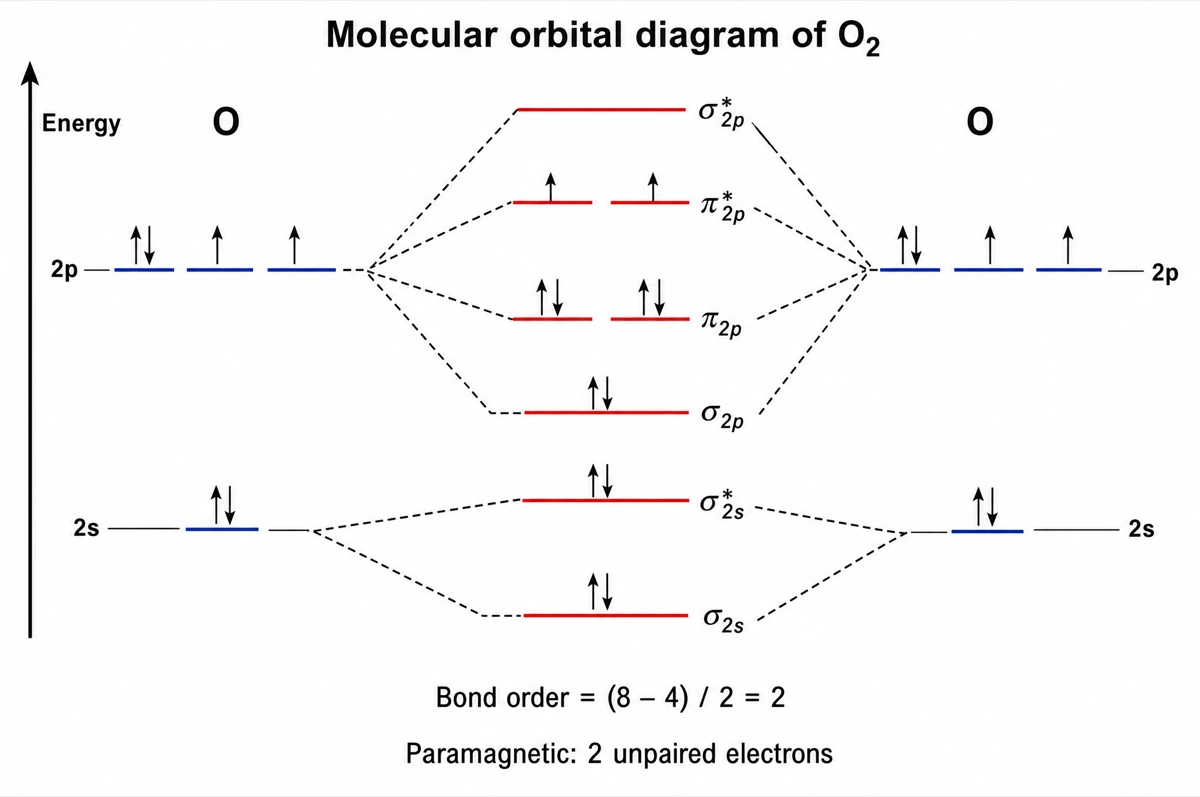
Labeled molecular orbital diagram of O₂ (answer key)
The 2s and 2p orbitals of both oxygen atoms, every σ and π molecular orbital in order, all 12 valence electrons filled in, a bond order of 2 and the two unpaired π* electrons that make O₂ paramagnetic. Print it as the answer key, or hand it out as a revision sheet.
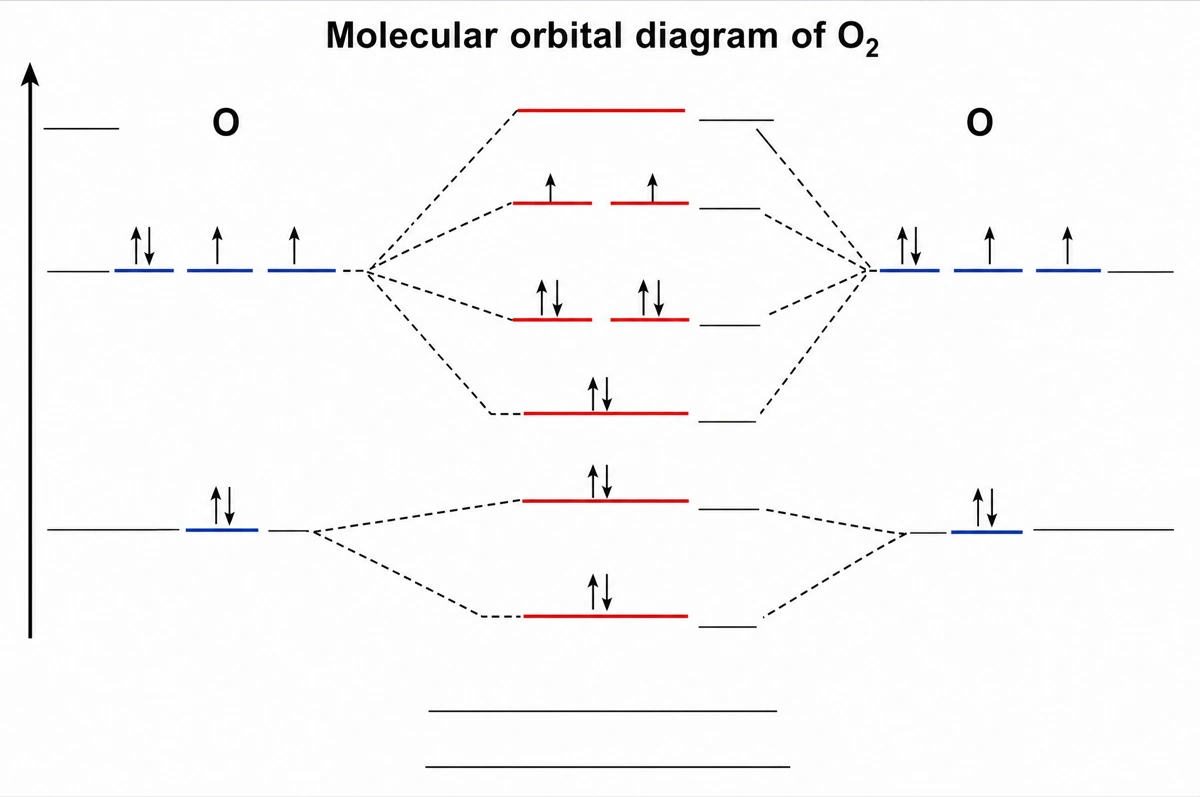
Blank molecular orbital diagram to label
The same O₂ drawing with its electrons kept and an empty answer line where every label was — students name each orbital and work out the bond order and the magnetism.
What is a molecular orbital diagram?
A molecular orbital (MO) diagram is an energy-level chart of a molecule: the atomic orbitals of each atom sit in the two outer columns, the molecular orbitals they combine into sit in the centre — bonding orbitals (σ, π) lower, antibonding orbitals (σ*, π*) higher — and the electrons are filled in from the bottom up. Counting them gives the bond order, (bonding − antibonding) / 2, and any unpaired electrons show that the molecule is paramagnetic.
Key facts
- The order of σ2p and π2p flips between N₂ and O₂. From Li₂ to N₂, s–p mixing pushes σ2p above the two π2p orbitals; in O₂ and F₂ the 2s–2p gap is too wide for that, and σ2p sits below π2p. An O₂ diagram drawn in the N₂ order is the most common error.
- Bond order = (bonding electrons − antibonding electrons) / 2. N₂ has 8 bonding and 2 antibonding valence electrons, bond order 3; O₂ has 8 and 4, bond order 2; He₂ would have 2 and 2, bond order 0 — so it does not form.
- MO theory explains why O₂ is magnetic. Its last two electrons go one each into the two π*2p orbitals of equal energy (Hund's rule), leaving two unpaired electrons — measurable on a magnetic balance, and invisible in a Lewis structure.
- As many orbitals come out as go in. Two 1s orbitals give σ1s and σ*1s; two sets of three 2p orbitals give σ2p, two π2p, two π*2p and σ*2p — six in, six out.
- In a heteronuclear molecule the two columns are uneven. For CO, NO or HF the more electronegative atom's orbitals sit lower, and the bonding orbitals lie closer to it in energy; NO, with 11 valence electrons, has a bond order of (8 − 3) / 2 = 2.5.
How does the molecular orbital diagram generator work?
Name the molecule
Say which molecule or ion and how much to show — a full O₂ diagram with every electron, a simple H₂ one, N₂ next to O₂. A sentence is enough.
Pick a style
The default is a clean flat textbook plate — white background, orbital lines, dashed correlation lines and half-arrow electrons. Or apply ink line art, 3D and other finishes.
Refine and export
The result opens in your workspace, where you can redraw regions, edit labels on the canvas, upscale and export in high resolution.
MO diagrams of the second-period diatomic molecules
Valence electrons, orbital order, bond order and magnetism for every homonuclear diatomic from Li₂ to Ne₂, as OpenStax Chemistry 2e lists them. The orbital-order column is the one to check first on any diagram.
| Molecule | Valence electrons | Order of the 2p orbitals | Bond order | Magnetism |
|---|---|---|---|---|
| Li₂ | 2 | π2p below σ2p (s–p mixing) | 1 | Diamagnetic |
| Be₂ | 4 | π2p below σ2p (s–p mixing) | 0 — does not form | — |
| B₂ | 6 | π2p below σ2p (s–p mixing) | 1 | Paramagnetic, 2 unpaired π electrons |
| C₂ | 8 | π2p below σ2p (s–p mixing) | 2 | Diamagnetic |
| N₂ | 10 | π2p below σ2p (s–p mixing) | 3 | Diamagnetic |
| O₂ | 12 | σ2p below π2p | 2 | Paramagnetic, 2 unpaired π* electrons |
| F₂ | 14 | σ2p below π2p | 1 | Diamagnetic |
| Ne₂ | 16 | σ2p below π2p | 0 — does not form | — |
Only the 2p order moves. σ2s and σ*2s sit at the bottom and σ*2p at the top in every one of these; what changes is whether σ2p lies above the two π2p orbitals (Li₂ to N₂) or below them (O₂ to Ne₂). Name the molecule and the diagram is drawn in its order.
Bonding vs antibonding molecular orbitals: what is the difference?
A bonding orbital (σ, π) builds up electron density between the two nuclei and lies lower in energy than the atomic orbitals that formed it; an antibonding orbital (σ*, π*) has a node between the nuclei and lies higher. Electrons in bonding orbitals hold the atoms together; electrons in antibonding orbitals cancel part of that out.
| Bonding orbital | Antibonding orbital | |
|---|---|---|
| Symbol | σ, π | σ*, π* — the asterisk marks antibonding |
| Energy | Lower than the atomic orbitals it comes from | Higher than the atomic orbitals it comes from |
| Electron density between the nuclei | Increased — the waves add up | Zero at a nodal plane — the waves cancel |
| Effect on the bond | Each electron adds ½ to the bond order | Each electron takes ½ off the bond order |
| Place on the diagram | Below the atomic orbital lines | Above the atomic orbital lines |
| In O₂ | σ2s, σ2p, two π2p — 8 electrons | σ*2s, two π*2p — 4 electrons; σ*2p empty |
Check the half-arrows first: paired arrows point opposite ways, orbitals of equal energy take one electron each before any pairing (Hund's rule), and no line holds more than two. O₂'s two π* electrons drawn as a pair is the error to look for.
Where are molecular orbital diagrams used?
Molecular orbital diagrams are used mostly in general and inorganic chemistry teaching — homework, exam revision and lecture slides — and in research talks on bonding, spectroscopy and materials. What changes is the molecule: H₂ and He₂ in a first course, the second-period diatomics and CO later, frontier orbitals in organic and materials chemistry.
General chemistry
AP Chemistry, A-level and first-year university courses: MO diagrams of H₂, He₂ and the second-period diatomics, with the bond order and the magnetism read off the filled diagram.
Inorganic chemistry
Heteronuclear diatomics such as CO, NO and HF, where the more electronegative atom's orbitals sit lower — the groundwork for metal–carbonyl bonding and ligand field theory.
Exam revision
One-page comparisons such as N₂ against O₂ that show the orbital-order swap — the most tested point in the topic — beside their bond orders and unpaired electrons.
Research and teaching figures
Schematic HOMO and LUMO energy diagrams for talks and papers in photochemistry, organic electronics and catalysis, where the gap between the two sets what a molecule absorbs.
Common questions about molecular orbital diagrams
What should a labeled molecular orbital diagram include?
The atomic orbitals of each atom in the outer columns, every molecular orbital in the centre with its name (σ2s, σ*2s, σ2p, π2p, π*2p, σ*2p), dashed lines joining them, the electrons as half-arrows and an energy axis pointing up. Most courses also want the bond order and whether the molecule is paramagnetic or diamagnetic written beside it.
Can I get a blank molecular orbital diagram for students to fill in?
Yes — view the blank O₂ version on this page free, or ask for any molecule with empty orbital lines and every label replaced by an answer line. The labeled version is the matching answer key, so the two print as a pair.
Why is O₂ paramagnetic?
Because its last two valence electrons sit one each in the two π*2p orbitals, unpaired. The two orbitals have the same energy, so Hund's rule places one electron in each before any pairing. A Lewis structure pairs every electron in O₂ and cannot explain why liquid oxygen clings to a magnet; the MO diagram can.
Why do N₂ and O₂ have different orbital orders?
Because of s–p mixing. From Li₂ to N₂ the 2s and 2p orbitals are close in energy, their σ combinations mix, and σ2p is pushed up above the two π2p orbitals. In O₂ and F₂ the 2s–2p gap is wider, the mixing is too weak to change the order, and σ2p stays below π2p.
How do you calculate bond order from a molecular orbital diagram?
Count the electrons in bonding orbitals and in antibonding orbitals, subtract, and divide by two. For O₂: 8 bonding (σ2s, σ2p, two π2p) minus 4 antibonding (σ*2s, two π*2p) gives (8 − 4) / 2 = 2 — the double bond of its Lewis structure. A bond order of 0, as for He₂ or Ne₂, means the molecule does not form.
How do you draw an MO diagram for a heteronuclear molecule like CO or HF?
Put the more electronegative atom's orbitals lower, in its own column. In CO, oxygen's 2s and 2p sit below carbon's, and its 10 valence electrons — the same count as N₂ — give a bond order of 3. In HF, the hydrogen 1s combines with one fluorine 2p orbital into a σ and σ* pair, while fluorine's 2s and its other two 2p orbitals stay nonbonding: bond order 1.
What is the difference between an MO diagram and a Lewis structure?
A Lewis structure draws bonds as shared electron pairs between two atoms; an MO diagram spreads the electrons over orbitals of the whole molecule, sorted by energy. Both usually give the same bond order, but only the MO diagram shows unpaired electrons like O₂'s or a fractional bond order like the 2.5 of NO. The Lewis structure generator on this site draws the other one.
Is a molecular orbital diagram the same as an orbital diagram?
No — an orbital diagram shows one atom's electron configuration, a molecular orbital diagram shows two atoms' orbitals combining. An orbital diagram draws 1s, 2s, 2p and so on as boxes or lines with up to two arrows each; the MO diagram puts two of those in the outer columns and the molecule's orbitals between them. Ask for either one here.
Can I make MO diagrams for molecules with more than two atoms?
Yes, as qualitative diagrams — the π system of benzene, the orbitals of water, a HOMO–LUMO gap. The levels are drawn in their textbook order, not at computed energies; if you have values from a quantum chemistry program, give them in the request and the diagram follows your numbers.
How is this different from a generic AI image tool?
The subject brief is built in. Every render is instructed to follow the textbook drawing — energy upward, σ2p below π2p for O₂ and F₂ but above it from Li₂ to N₂, degenerate orbitals half-filled before pairing, every orbital named σ, σ*, π or π* exactly. Check the diagram against your course before printing; the canvas lets you correct any label in place.
Can I use the diagrams for school, teaching or publication?
Yes — diagrams you generate are yours to use in worksheets, presentations, handouts, theses and papers. Export high-resolution raster up to 4K depending on the model.
Can I change the labels after generating?
Yes. The result opens in a canvas workspace that recognizes the diagram labels — you can edit or translate the text, move lines, redraw a region or recolor without regenerating the whole figure.
Keep exploring
Our other diagram tools, and the guides behind them.

Draw your molecular orbital diagram
From a molecule's name to a labeled energy-level diagram in about a minute.
Start drawing